Cone Penetration Testing (CPT)

  • Used for site characterisation and soil sampling
  • Digital CPT piezocones to measure cone tip resistance (qc), sleeve friction (fs), pore water pressure (u), inclination (Ix/y) & temperature (T)
  • Range of CPT rigs from portable lightweight CPT skids to CPT crawlers and truck mounted CPT rigs
  • Click on modules for down hole shear vane, seismic, conductivity and magneto

Insitutek have partnered with renowned Dutch Cone Penetration Testing (CPT) equipment manufacturer, A.P. van den Berg, and we represent them in the Pacific Region including in Australia and New Zealand. For more than 50 years, A.P. van den Berg has designed and manufactured advanced CPT equipment and is well-known for their innovations and robust high quality equipment. A.P. van den Berg supplies complete or partial systems including the pushing equipment, tools and data acquisition systems. Our Cone Penetration Testing rigs use hydraulic rams to push 36 mm diameter rods into the soil from either a ballasted CPT truck, ballasted CPT track-truck, ballasted or anchored CPT crawler, anchored CPT trailer or anchored portable CPT skids.

What is Cone Penetration Testing?

Cone Penetration Testing (CPT) uses a cylindrical instrumented cone pushed vertically into the ground at a constant rate of penetration of 2 cm/sec to identify subsurface conditions down to 40m or more, depending on the pushing equipment and soil conditions. The collected data allows reliable interpretation of soil strength and stiffness parameters, and the soil type.

Cone Penetration Testing uses hydraulic rams to push 36 mm diameter rods into the soil from a ballasted truck, ballasted track-truck, ballasted or anchored crawler, anchored trailer or anchored portable skids.

A CPT conducted to a depth of 25 m will take about 2 hours. This is much quicker, and therefore cheaper, than drilling, which may take a day or more and would not provide the same level of detailed useful subsurface information.

In situations where the CPT is unsuitable (e.g. course gravels up to 150mm), the GRIZZLY® Dynamic Probing Super Heavy (DPSH) is a suitable alternative, benefitting from dynamic energy to penetrate stiff and very stiff materials.

Applications of Cone Penetration Testing (CPT)

CPT is a rapidly developing site investigation technique with a wide range of applications, including:

  • Geotechnical: CPT provides information on the soil profile, which can be used to design foundations, provide quality control for ground improvement work or to check the condition of a levee or a dike, for example.
  • Hydrogeological: to analyse the level and flow of groundwater or the interaction between groundwater and the surrounding soil.
  • Geo-environmental: to check the length of unknown foundations or the presence of buried steel objects, but also to determine the presence of contaminants in the soil.

To obtain detailed and accurate geotechnical properties of soils, A.P. van den Berg developed the Icone, a digital CPT piezocone, and Icontrol, a digital data logger. Our cones are now manufactured and calibrated according to ISO 22476-1:2022 Geotechnical Investigation and Testing — Field Testing Part 1: Electrical Cone and Piezocone Penetration Test. The Icone measures the four standard CPT parameters:

  • cone tip resistance (qc)
  • sleeve friction (fs)
  • pore water pressure (u)
  • inclination (Ix/y)

An option is to be able to measure temperature at the cone tip, an important parameter for accurate cone resistance measurements when pushing through stiff material. According to ISO 22476-1:2022, Class 1 and Class 0 cones include temperature (T) measurement.

Cone tip areas range from 5cm2 – 15cm2 with 10cm2 being the most common. A CPT cone measuring pore water pressure is known as a piezocone and CPTu is reported.

ISO 22476 2022

Cone Penetration Test (CPT) Sales, Calibration, Service and Spare Parts

Insitutek are proud to represent A.P. van den Berg Cone Penetration Test (CPT) equipment in Australia, New Zealand and the Pacific Islands. We provide a high level of client support, from technical pre-sale consultations and supply of equipment to commissioning, user training, after-sale technical support, servicing, repairs, and calibrations. Our service centre is also well stocked with spare parts and consumables.



To find out more, Contact Us.

Here is the range of CPT rigs and pushing systems for soil investigations and site characterisation on land or over shallow water.

Click-On Modules for down hole Electrical Vane Shear Testing (EVST), Seismic CPT (SCPT), Conductivity and Magneto are available. By having each module attached to a CPT or CPT(u) cone, our digital CPT data acquisition system allows simultaneous acquisition of CPT / CPT(u) data and module data. All modules can be used with a 10 cm2 or 15 cm2 Icone. When CPT-data are not required, the click-on modules can also be used with a dummy tip instead.

Almost undisturbed soil samples can be rapidly collected with the use of A.P. van den Berg’s MOSTAP sampler. Continuous core sampling can be performed in runs up to 1.0 m or by discrete sampling at any depth.

-
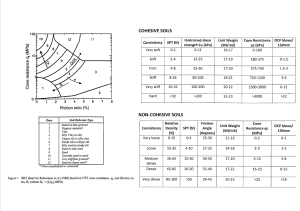
CPT Correlation Table

CPT Correlation Table

Categories: Research Papers

Published: 12/08/2024

This correlation table covers:

COHESIVE SOILS - SPT (N) Undrained shear strength Cu (kPa), Unit Weight (kN/m3), Cone Resistance qc (kPa) and DCP blows/150mm

NON-COHESIVE SOILS - Relative Density (%), SPT (N), Friction Angle (degrees), Unit Weight (kN/m3),  Cone Resistance qc (MPa) and DCP blows/150mm

Keywords: Cone Penetration Test - CPT

Technical note on calibration for CPT in Soft Soil CPTu - Scholey ISC7 2024

Technical note on calibration for CPT in Soft Soil CPTu - Scholey ISC7 2024

Categories: Research Papers

Published: 01/07/2024

Even the most experienced geotechnical engineer is likely to assume that the results of cone penetration tests are unquestionably accurate, reliable and repeatable. There are, however, multiple factors, some that have nothing to do with the soil properties, that need to be carefully addressed prior to testing if the equipment is to return results that can be relied on for design purposes. In soils which are very soft or soft, cone penetration test results can be particularly sensitive to the method of calibration. A high degree of rigour to the calibration process is required, otherwise there is a risk that the results obtained could be inaccurate and adversely impact on the reliability of the interpretation of design soil strength profiles. In this technical note sources of error in cone calibration are discussed. Reference is made to ISO 22476-1 which was revised in 2022, with the addition of a defined approach to calibration. Examples are used to demonstrate the typical errors that could be introduced during calibration.

Keywords: Cone Penetration Test - CPT

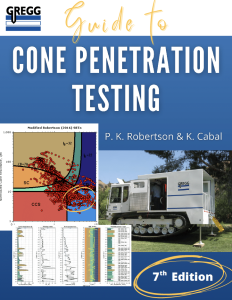
CPT Guide to Cone Penetration Testing 7th Edition Robertson & Cabal

CPT Guide to Cone Penetration Testing 7th Edition Robertson & Cabal

Categories: Research Papers

Published: 01/12/2022

The purpose of this guide is to provide a concise resource for the application of the CPT to geotechnical engineering practice. This guide is a supplement and update to the book ‘CPT in Geotechnical Practice’ by Lunne, Robertson and Powell (1997). This guide is applicable primarily to data obtained using a standard electronic cone with a 60-degree apex angle and either a diameter of 35.7 mm or 43.7 mm (10 or 15 cm2 cross-sectional area). Recommendations are provided on applications of CPT data for soil profiling, material identification and evaluation of geotechnical parameters and design.

The companion book (Lunne et al., 1997) provides more details on the history of the CPT, equipment, specification, and performance. The companion book also provides extensive background on interpretation techniques. This guide provides only the basic recommendations for the application of the CPT for geotechnical design.

Keywords: Cone Penetration Test - CPT

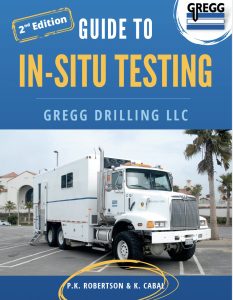
Guide to Insitu Testing Guide 2nd Edition Robertson & Cabal 2022

Guide to Insitu Testing Guide 2nd Edition Robertson & Cabal 2022

Categories: Research Papers

Published: 01/10/2022

The purpose of this guide is to provide a concise summary on in-situ testing and its application to geotechnical engineering. The aim of in-situ testing is to define soil stratigraphy and obtain measurements of soil response and geotechnical parameters.

The common in-situ tests include the Standard Penetration Test (SPT), Cone Penetration Test (CPT), Flat Plate Dilatometer (DMT), Field Vane Test (FVT) and Pressuremeter Test (PMT). Each test applies different loading schemes to measure the corresponding soil response to evaluate material characteristics such as strength and stiffness. Boreholes are required for the SPT and some versions of the PMT and FVT. For the CPT and DMT no boreholes are needed, and the term ‘direct-push’ is often used. An advantage of direct-push technology is that no cuttings are generated. However, a disadvantage of the direct-push method is that hard cemented layers, bedrock, and some gravel layers can prevent further penetration.

The guide has an emphasis on the Cone Penetration Test (CPT) and the Standard Penetration Test (SPT) since these are the most used in-situ tests in North America. Each country tends to have a preferred in-situ test based on historical precedent and local geology. The section on the CPT is a shorter version of the “CPT Guide” that is applicable to data obtained using a standard electronic cone with a 60-degree apex angle and a diameter of either 35.7 mm or 43.7 mm (10 cm2 or 15 cm2 cross-sectional area). The section on the SPT is applicable to data obtained following ASTM standard D1586-99.

Keywords: Cone Penetration Test - CPT, Dilatometer Marchetti Test - DMT, Vane Shear Test VST

Adoption of ISO 22476-1-2022 Standard for Cone Penetration Testing (CPT)

Our CPT partner, A.P. van den Berg, has switching to the new ISO-standard ISO 22476-1:2022 for CPT cone manufacture and calibration.

Webinar Invitation: Exploring the New PANDA DCP WebSprint Module for Liquefaction Risk Estimation

We are excited to introduce the addition of a new Liquefaction Risk Estimation module in WebSprint©. Paired with our cutting-edge products, PANDA® and GRIZZLY®, this module enables you to assess the liquefaction risk...

Get Cone Penetration Testing (CPT) equipment from A.P. van den Berg with local Insitutek support

We are delighted to welcome A.P. van den Berg to our small portfolio of innovative organisations we are a distribution partner for. Our clients have kept telling us about the importance...

Trusted by our clients

Trusted by our partners

Insitutek Blogs