
Current earthworks specifications often rely on the assumption that there is a direct correlation between density and modulus (i.e. the greater the density achieved, the higher the modulus of the compacted material). As a result, existing specifications often require that Nuclear Density Gauge (NDG) tests be conducted to demonstrate that adequate density was achieved within the earthwork layers. However, the assumptions used when converting density to modulus have been shown to be highly idealised, and they can be affected by the properties of the compacted fill, subgrade or base material. More importantly, testing has shown that a higher density does not necessarily indicate a higher strength or modulus (Mooney et al. 2003, Mooney et al. 2010).
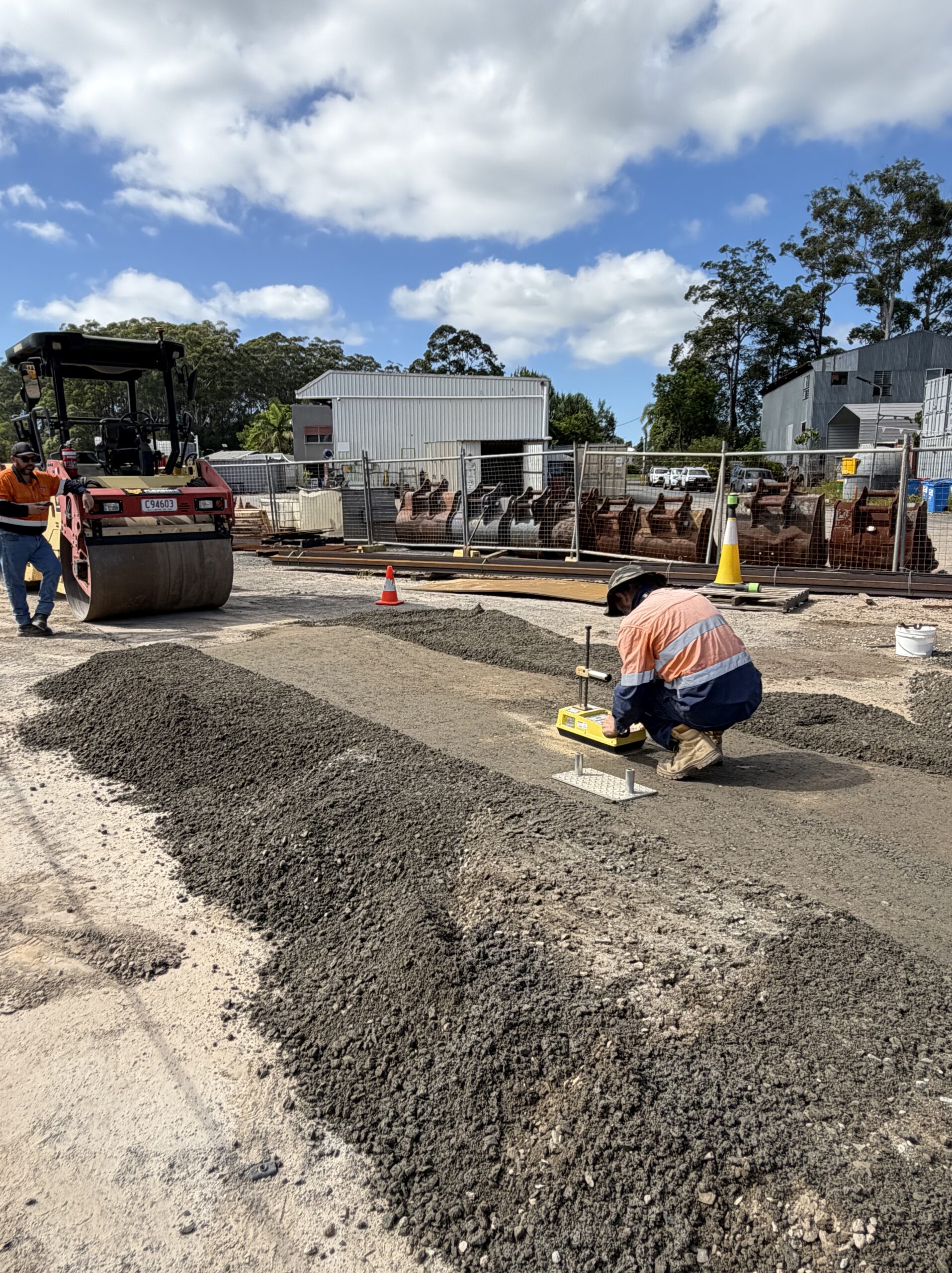
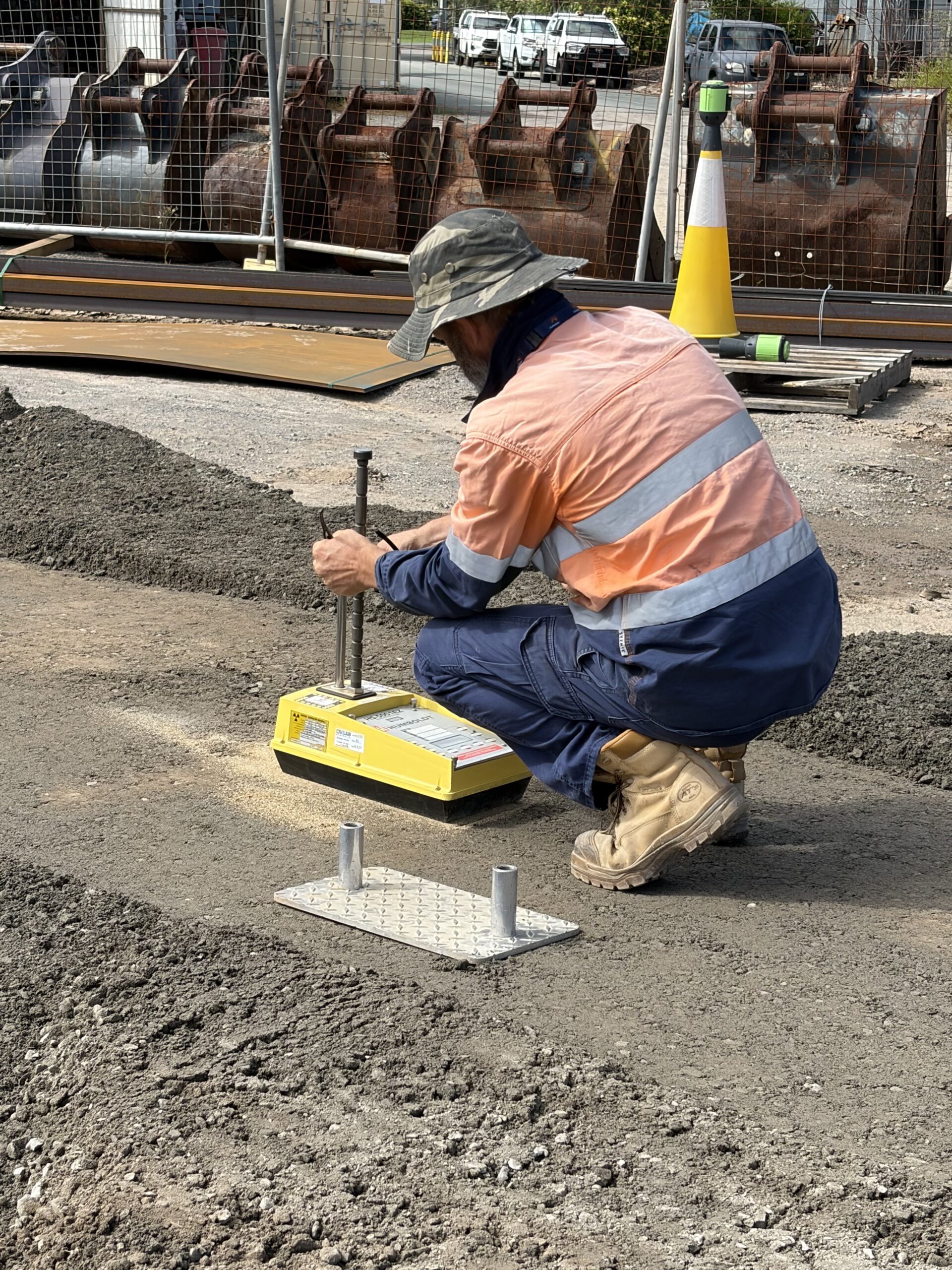
Issues with a reliance on density testing for QA purposes include:
-
Lag indicators – Several days / one week typical to complete. Contractor typically continues work and advances fill placement above the lift – before QA results are available. If non-conforming QA test results are then made available, there are significant costs associated with removing and replacing both the non-conforming material and the overlying material that has been placed whilst the contractor was waiting for the results.
-
Density Oversize correction – This applies when greater than 20% of material exceeds 19 mm or 38 mm for Mould A and B size, respectively. This is not consistently being applied across the industry, with a recent study showing that 22% of 235 samples examined not applying that correction (FSG Geotechnics + Foundations).
-
Strength and modulus parameters – geotechnical and pavement designs are based on strength and modulus values. It is assumed during the design stage that a relationship exists between density and strength/modulus even though density is neither a strength nor a modulus parameter.
For more details on these issues, check out the latest research.
To conclude, modulus is the most accurate and independent means for judging deformation (stiffness) and, thus, a materials level of compaction. Modern geotechnical and pavement designs are based on in-situ modulus values.
So, are you aware of how alternatives to traditional approaches to assess compaction are specified in our region?
New Zealand
New Zealand has made the most progress. Here is how they are handled in their standard.
NZS 4431:2022 Standard - Engineered fill construction for lightweight structures
C3.6.2 Compaction acceptance testing
Traditionally, compaction has been assessed with reference to either a maximum dry density and percentage air voids or a relative density. Other methods to evaluate whether adequate compaction (and therefore adequate strength or stiffness) has been achieved in an engineered fill include:
-
Undrained shear strengths;
-
California bearing ratios (CBR);
-
Impact values (IV);
-
Lightweight deflectometers;
-
Dynamic cone penetrometers (such as Scala penetrometers);
-
Nuclear density meters (NDM); and
-
Plate load tests.
Indirect methods such as an impact value associated with a 4.5 kg impact soil tester (a Clegg hammer), or the use of a dynamic cone penetrometer (a Scala penetrometer) should only be included as additional to traditional methods of control. These could allow the frequency of traditional tests to be reduced where consistent relationships can be determined. In cases where such methodologies are being used, relationship testing for each material being compacted should be carried out to establish the link between the measured property and the degree of compaction.
3.6.4 Alternative tests and acceptance criteria
Alternative testing methods could be accepted if the geotechnical designer and certifier agree that these provide at least the same degree of confidence in the strength, stiffness, and stability of the fill.
C3.6.4 Intelligent compaction (IC)
Intelligent compaction (IC) and continuous-compaction control (CCC) systems provide real-time measurements related to the degree of compaction that has been achieved. These systems have the potential to offer significant benefits to larger developments, which include a more optimised compaction process, and an enhanced ability to identify potential problem areas (and their extent) within an engineered fill that requires further investigation. It is important to note that in order to be used successfully, the monitoring equipment on the IC system should be regularly calibrated (with Plate Load Test, Light Weight Deflectometer and Variable Energy Dynamic Penetrometer – Insitutek note), and threshold measurements for acceptability criteria should be determined for each material through field compaction trials. In the field compaction trials, the IC measurements should be correlated to the geotechnical designer’s compaction requirements.
The NZS 4431:2022 Standard is complimented by the New Zealand Geotechnical Society (NZGS) Earthworks Specification.

NZGS Specification - NZGS_0510 Earthworks 15/02/2024
In it, emerging test alternatives are described:
-
Plate load test (PLT) to DIN 18134 or Light Falling Weight Deflectometer (LFWD) to ASTM E2835-11, when specified by the Geotechnical Designer and agreed by Engineer and Certifier
-
Minimum and acceptable range for in-situ dynamic soil modulus EvD for the soil and rock type. For well compacted soils the ratio of Ev2 over Ev1 is greater than 1 and less than 2.6
-
Expected test frequency minimum 5 per 1000m3 and minimum 5 per lift
-
Can be used in combination with calibrated continuous compaction control (CCC)
-
Useful reference: Barounis, N. & Smith, T. (2017) – Proc. 20th NZGS Geotechnical Symposium
Increasingly, we are seeing laboratories becoming IANZ accredited for these methods.
The National Pavement Technical Group (NPTG) have authored Intelligent Compaction: New Zealand Best Practice Guide 2025, a guide that covers Intelligent Compaction (IC) and Continuous Compaction Control (CCC) for compacting pavement layers, including asphalt, modified granular, unbound granular and SIL/subgrade layers.

Australia
In Australia, we are now seeing alternative approaches to compaction control being baked into project specific technical specifications. The alternative approaches include:
An example is the Department of Transport and Main Roads Queensland (TMR) PSTS116 Intelligent Compaction – Earthworks & Pavements specification developed for the Rocklea to Darra – Stage 1 Project.
Further, there is Test Method Q258A Dynamic Modulus of Deformation Light Falling Weight Device Accelerometer Type, a how to carry out the test type standard for Light Weight Deflectometers (LWD’s). The standard has been developed by Department of Transport and Main Roads Queensland (DTMR) and is based on the ASTM E2835: Standard Test Method for Measuring Deflections using a Portable Impulse Plate Load Test Device and TP BF-StB Part B 8.3 Dynamic Plate Load Testing with the Light Drop-Weight Tester. Our Zorn LWDs are fully compliant with Q258A.
For other methods, we are seeing international standards being adopted and some clients becoming NATA / ALAB accredited to them. These include:


Moving from Density to Modulus - Technical Note
Lastly, a valuable draft technical note on moving from density to modulus has been developed and road tested on multiple large and smaller scale construction projects. Guidance on Use of Light Weight Falling Deflectometers (LWDs) to be Accepted as an Alternative Method for Verification of Earthworks Compaction Requirements was published in June 2021.

You’ll find practical guidance on moving from a density based specification for compaction control to a modulus based approach to testing in the field. We believe this “How to” guide is very useful for industry on projects across the region.

