Intelligent Compaction / Continuous Compaction Control with Völkel Navigator

  • Roller mounted real-time compaction monitoring for earthworks, aggregate and asphalt layers
  • Measures compaction uniformity and coverage
  • Retrofit regardless of manufacturer – suitable for use on most roller types
  • Increase rates of construction, lower cost, improve quality, reduce risk and reduce your environmental footprint
  • Meets Department of Transport and Main Roads Queensland (TMR) PSTS116 Intelligent Compaction – Earthworks & Pavements specification

Compaction is one of the most important processes in civil engineering projects, including bulk earthwork, foundations, backfilling, and pavements. Ensuring high-quality compaction is crucial for the resilience and longevity of infrastructure.

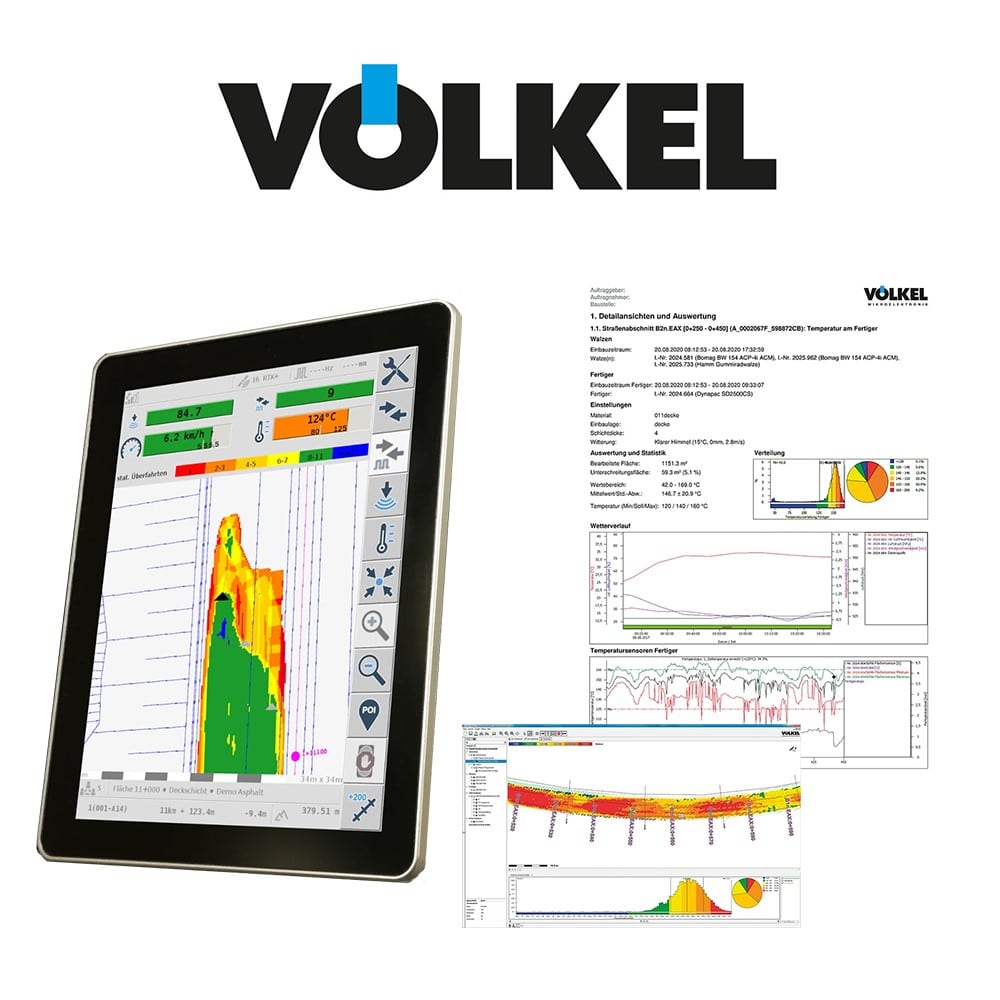
Intelligent Compaction (IC) or Continuous Compaction Control (CCC) refers to the compaction of pavement materials, such as granular soils, cohesive soils, aggregate bases and subbase and asphalt, using vibratory rollers equipped with an integrated stiffness measurement system, an onboard computer reporting system and Global Positioning System (GPS) based mapping. Asphalt temperature can also be assessed.

The Völkel Navigator Intelligent Compaction system includes:

  • Pass count tracking
  • Pavement response (an indication of stiffness) – optional
  • Temperature measurement for asphalt
  • QC and QA reporting

Rollers, regardless of manufacturer, retro-fitted with the Völkel Navigator Intelligent Compaction system:

Völkel Navigator Intelligent Compaction
Intelligent Compaction Völkel Navigator Asphalt
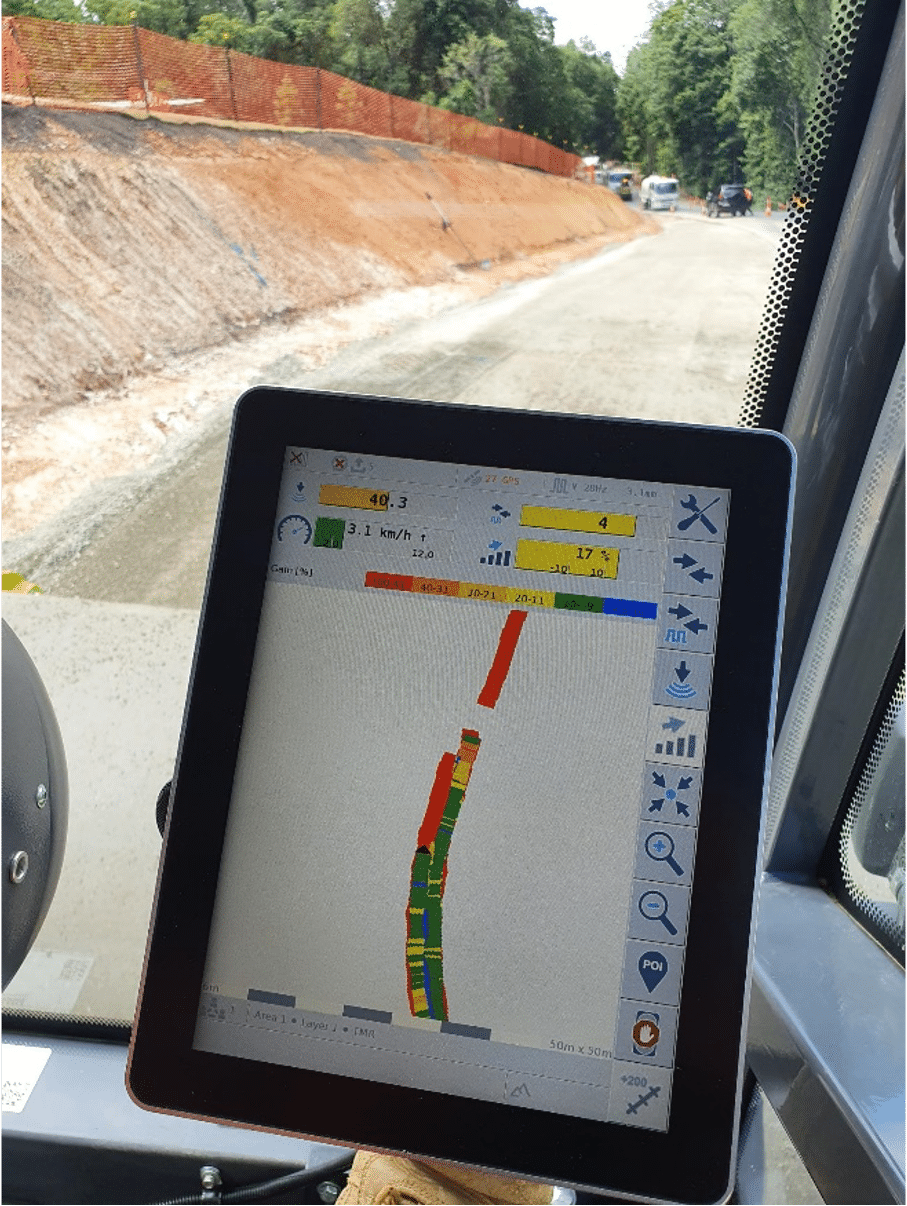
  • Capture on-the-fly real time feedback for the operator and a continuous record of the compaction process with colour-coded plots such as pass counts, pass overlap, stiffness, gain (change in stiffness pass to pass), and temperature (asphalt only)
  • Measure compaction uniformity and provides 100% coverage
  • Provide real time data synchronisation between rollers, giving all operators a unified, live view of compaction progress – enabling a complete, synchronised picture of the site’s status directly on each operator display
  • Standardise the proof rolling process, overcoming subjective arguments
  • Offer all in one transparency, analysis, remote access, and documentation

To calibrate the material stiffness measurements, Light Weight Deflectometer and Plate Load Test in situ testing methods are typically used.

The Völkel Navigator Intelligent Compaction system can be retrofit, regardless of roller manufacturer and equipment type.

Voelkel Intelligent Compaction Display with Logo

How Intelligent Compaction empowers the roller operator

The Völkel Navigator Intelligent Compaction technology is a game changer providing reliable information on compaction which helps to:

  • Avoid over compaction (which can damage compacted material)
    • Commonly leads to ~30% increase in rolling productivity with time savings (operator & roller hours), less fuel burn, lower roller maintenance costs
    • Eliminating increased material usage due to over compaction – importing additional material can be a major unanticipated project cost
  • Avoid under compaction & gaps between passes (which leading to less defects and longer lasting pavement layers)
  • Detect soft spots and anomalies and understand compaction uniformity
  • Provide 100% coverage – overcoming the issues with a limited number of spot tests for Quality Assurance purposes
  • Confidently move on to placement of the next layer (without waiting for traditional test results)
  • Detect soft spots and anomalies to establish base layer material uniformity (smart proof rolling) e.g. after asphalt removal, prior to laying fresh asphalt
  • Provide better ‘vision’, enabling operators to see a complete synchronised picture of the site compaction status, real time on their cab display
  • Gamifies the operators ‘vision’ empowering them to take more ownership of their work delivering better compaction outcomes
  • Accelerate operator skill development by providing visual feedback
Völkel Navigator Intelligent Compaction Soils Display

What does Intelligent Compaction enable?

Our clients use our Völkel Navigator Intelligent Compaction system to create uniform efficient quantified compaction which increases construction productivity, lowers cost, improves quality, reduces risk and reduces their environmental footprint. At a high level, well implemented, it can lead to increased pavement life and reduced maintenance costs.

From a site management perspective, Intelligent Compaction drives continuous improvement:
  • Real time visibility of construction site compaction progress, remotely, is a game changer – this enables potential issues to be flagged and addressed close to real time.
  • One of the challenges for construction teams is the experience base of the roller operators – tools like Playback Videos allow supervisors and operators to review whole shifts of work in a few minutes, identifying opportunities for learning.
  • Software enables you to review layer by layer roller pass counts & coverage, pavement response (stiffness), speed, vibration (amplitude & frequency) and oscillation.
  • By having an objective standardised proof rolling process, the subjectivity is reduced, and disputes are minimised.
  • Process improvement opportunities become clear – e.g. with asphalt, temperature-based compaction control ensures rollers work within the optimal thermal window.
  • If a non-conformance does occur, it’s easier to isolate the root cause and eliminate this from becoming a recurring issue.

Intelligent Compaction leads to lowering construction costs:

  • Enabling continuous placement of material with confidence (without waiting for traditional test results)
  • Time savings (operator and roller hours)
  • Less fuel burn
  • Lower roller maintenance costs
  • Eliminating increased material usage due to over compaction – importing additional material can be a major unanticipated project cost
  • Reducing financial penalties during asphalt pavement rehabilitation, by smart proof rolling base layer material and understanding uniformity, leading to meeting density requirements for compacted asphalt
  • Using Völkel Navigator Intelligent Compaction system in combination with the PANDA Variable Energy DCP and Light Weight Deflectometer, there is potential to increase placed loose layer lift thicknesses with confidence. This is next level, helping to further increase rates of construction, lower cost, improve quality, reduce risk and reduce your environmental footprint.

Currently, the in-situ density of layers is primarily assessed using nuclear density gauge or sand replacement method and using cores extracted from the compacted layer for asphalt. These are destructive methods measuring density, not modulus, that provide very limited coverage.

The Völkel Navigator Intelligent Compaction system meets the Department of Transport and Main Roads Queensland (TMR) PSTS116 Intelligent Compaction – Earthworks & Pavements specification, the first of it’s kind in Australia.

Intelligent Compaction Blind Test Improved Rolling Pattern
Völkel Intelligent Compaction Smoothdrum Roller Earthworks
Völkel Intelligent Compaction Asphalt Tandem Roller

For more insights and case studies on “Intelligent Compaction – Reducing Over & Under – Compaction & Increasing Compaction Uniformity“, you can review a technical paper presented at 20th AfPA International Conference 2025 | Future Ready Roads co-authored by our Chief Executive, Robin Power.

To find out more, Contact Us.

Intelligent Compaction using the Völkel Navigator
Salzburg Airport Runway Asphalt Resurfacing with the VÖLKEL Navigator
Intelligent Compaction VÖLKEL Navigator
-
Intelligent Compaction New Zealand Best Practice Guide - National Pavement Technical Group NPTG 2025

Intelligent Compaction New Zealand Best Practice Guide - National Pavement Technical Group NPTG 2025

Categories: Research Papers

Published: 18/11/2025

The National Pavement Technical Group (NPTG) has prepared this best practice guide for the use of Intelligent Compaction (IC) in New Zealand, including Continuous Compaction Control (CCC), while compacting pavement layers, including asphalt, modified granular, unbound granular and SIL/subgrade layers.

The purpose of this guide is to provide a background to IC, plus guidance on:

  • how to make best use of IC technology to achieve productivity gains & uniformity in compaction
  • interpretation and use of the measured data
  • limitations of IC
  • how to determine CCC values for specific materials and conditions.

NPTG has collated information from overseas studies and New Zealand IC users to share industry’s knowledge on the use of IC. This guideline aligns with:

  • Performance-based specifications
  • Digital construction initiatives
  • Sustainability goals through reduced rework and material waste

Challenges experienced while using IC are discussed, including best practice for developing correlations between the CMV and traditional in-situ measurements.

Keywords: Intelligent Compaction

Intelligent Compaction - Reducing Over & Under Compaction & Increasing Compaction Uniformity - AfPA - Power & Rosie Oct 2025

Intelligent Compaction - Reducing Over & Under Compaction & Increasing Compaction Uniformity - AfPA - Power & Rosie Oct 2025

Categories: Research Papers

Published: 05/11/2025

Compaction is one of the most important processes in pavement construction and, done well, leads to long-lasting pavements and reduced maintenance costs.

The objective of Intelligent Compaction (IC) is to create uniform, efficient, quantified compaction.

IC uses instrumentation mounted on a roller compacting soil or asphalt to accurately assess location, speed, an indication of stiffness, and temperature for asphalt.

Using case studies, we will show how IC technology can:

  • Provide real-time compaction monitoring for earthworks and asphalt layers on any machine regardless of roller manufacturer with a continuous record of the compaction process with colour-coded plots
  • Help attain uniform high-quality compaction with 100% coverage and detection of soft spots
  • Provide better 'visibility' to roller operators, enabling them to view a complete synchronised picture of the site compaction status, real time on their cab display
  • Standardise the proof rolling process, overcoming subjective arguments
  • Offer all in one transparency, analysis, remote access, and documentation

Providing on-the-fly real time feedback to the operator helps to:

  • Avoid over compaction which can damage compacted material and thereby improve rolling productivity (~30% is common – see case studies in Section 6)
  • Avoid under compaction & gaps between passes leading to fewer defects and longer lasting and more durable pavement layers

The case studies also highlight the valuable training aid IC is for roller operators. From a contractor perspective, IC improves quality, increases construction rates, lowers cost, reduces risk and reduces environmental footprint. For the asset owner, it provides Quality Assurance.

Keywords: Intelligent Compaction

Influence of Initial Stiffness and Foundation Uniformity on Pavement Performance - MnDOT 2025

Influence of Initial Stiffness and Foundation Uniformity on Pavement Performance - MnDOT 2025

Categories: Research Papers

Published: 12/09/2025

Durability of pavement systems depends not only on advanced materials, design methods, and thickness of structural layers, but also on the uniformity and initial stiffness of foundation layers. Non-uniform foundation layers can induce localized stress concentrations, accelerating pavement deterioration. This study evaluates the influence of initial stiffness and pavement foundation uniformity on pavement performance through a detailed analysis of six test sections constructed at the Minnesota Road Research Facility (MnROAD). Intelligent Compaction (IC) testing was used to evaluate stiffness and uniformity during construction, while Falling Weight Deflectometer (FWD) data were analysed to assess long-term performance. A probabilistic approach, including cumulative distribution functions (CDF), probability density functions (PDF), coefficients of variation (COV), and kurtosis of the IC results, was used to quantify spatial uniformity. Semivariograms and heat maps were generated to deepen the investigation of uniformity. Distress mapping revealed a strong correlation between foundation non-uniformity and early initiation of pavement cracking. These findings underscore the critical role of foundation uniformity in mitigating stress concentrations and pavement distress.

Keywords: Intelligent Compaction

An Approach to Assess As-built Moduli of Compacted Foundation Layers Using Intelligent Compaction - Isaac Esteban Zuniga - ICTG 2024

An Approach to Assess As-built Moduli of Compacted Foundation Layers Using Intelligent Compaction - Isaac Esteban Zuniga - ICTG 2024

Categories: Research Papers

Published: 31/10/2024

The satisfactory performance of well-designed pavement sectionshinges on the appropriate compaction of layers in the field, especially compacted geomaterials forming the foundation layers. In-situ spot density tests are standard practice for assessing the compaction effort, even though the mechanistic-empirical design procedures are based on layer moduli. The state of the practice in in-situ density measurements, and more recently modulus measurements, relies on limited in-situ spot testing meant to represent a large area of compacted geo-material. Intelligent compaction (IC) can be utilized to access the as-built moduli by vibratory rollers across the entire compacted geomaterial area to overcome the limitation of spot density tests.

This paper presents an approach to assess the layer-by-layer variation in the as-built moduli. The real-time IC mapping process has proved to be practical, efficient, and robust. The assessment results can be obtained by combining the IC measurement values (ICMV) with limited lightweight deflectometer (LWD) measurements for local calibration and laboratory-based resilient modulus non-linear parameters. The method's veracity and applicability are demonstrated through comprehensive data from two cells collected during the Minnesota Road Research Facility (MnROAD) reconstruction. The assessment results showed that the local in situ calibration of the ICMVs with the limited LWD modulus is necessary to obtain accurate layer-specific as-built moduli.

Keywords: Intelligent Compaction, Light Weight Deflectometer

PSTS116 Intelligent Compaction - Earthworks and Pavements DTMR QLD January 2020

PSTS116 Intelligent Compaction - Earthworks and Pavements DTMR QLD Jan 2020

Categories: Technical Standards

Published: 20/04/2024

This Project Specific Technical Specification, PSTS116 Intelligent Compaction – Earthworks and Pavements, was developed for the Rocklea to Darra – Stage 1 Project by the Department of Transport and Main Roads Queensland.

This Project Specific Technical Specification applies to the use of intelligent compaction (IC) in the construction of pavements and earthworks including stabilised materials but excluding asphalt and sprayed seals.

Keywords: Intelligent Compaction

P105-Year-4-2021-2022-Implementation-of-Intelligent-Compaction-in-Queensland-PSTS116-Intelligent-Compaction-Earthworks-and-Pavements

P105 Year 4 2021-2022 Implementation of Intelligent Compaction in Queensland PSTS116 Intelligent Compaction Earthworks and Pavements.pdf

Categories: Research Papers

Published: 01/05/2023

As compaction is critical for the performance of pavement layers, intelligent compaction (IC) is a solution to the rapidly growing need in the road construction industry for faster, more efficient and reliable ways of collecting compaction data, assessing the work during earthworks and pavement construction and giving immediate feedback and indicative information to the roller operator, supervisors, project managers and road engineers to make informed decisions. This NACOE project commenced in the 2018–19 financial year to facilitate the implementation of IC technology in Queensland. A comprehensive literature review was undertaken during the first year to evaluate the potential benefits of such technology for the Queensland Department of Transport and Main Roads (TMR) and the wider road construction industry. Year 2 (2019–20 FY) focused on the development of a pilot project-specific technical specification which was successfully trialled on the Ipswich Motorway Upgrade project where the IC technology was trialled on different materials. The study showed that the compaction meter value (CMV) has varying degrees of correlation against the in situ stiffness measured by light weight deflectometer (LWD) and conventional density results (measured by a nuclear density gauge). It was also noted that the CMV is sensitive to in situ moisture conditions during construction. The project funded the Veta program to support the latest GDA2020 system, which became the main cadastral grid to be used across different jurisdictions in Australia. In year 3 (2020–21 FY), the priority was to disseminate the knowledge and local experience on IC technology and promote its benefits. While monitoring the demonstration field trials, different levels of training were developed to share the knowledge and practical findings. To better illustrate the benefits of IC technology, a benefit-cost analysis was undertaken to cover the impact/difference of using IC. In the current financial year, the focus of the project was to trial the use of IC technology for asphalt layers. After gaining some experience on a few small projects, an asphalt rehabilitation project was chosen to be delivered as an intelligent compaction project. Pre-mapping was also practiced as it is seen as one of the major benefits of using IC technology for asphalt projects (in identifying weak support areas prior to the paving of the hot mix asphalt overlay). The work provided the opportunity to understand the requirements and details of how the road agencies can monitor, oversee, quality control and accept an asphalt project and what are the required area of work in terms of specifications, technical standards and contracts. Results also showed that for the asphalt layer, the intelligent compaction meter value (ICMV) is dependent

Keywords: Intelligent Compaction

P105-Year-3-2020-2021-Implementation-of-Intelligent-Compaction-in-Queensland-PSTS116

P105 Year 3 2020 2021 Implementation of Intelligent-Compaction in Queensland PSTS116 Intelligent Compaction - Earthworks and Pavements

Categories: Research Papers

Published: 01/04/2023

This report is a summary of the activities undertaken during Year 3 (2020–21) of the project. This year’s priority was to disseminate knowledge and local experience with the use of IC technology and promote its benefits. As the demonstration field trials were monitored and further trials with different materials were planned, various levels of training were developed to effectively share the practical insights gained from field trials. This approach aimed to ensure that the findings and experiences from the trials could be effectively communicated and utilised to enhance understanding and expertise in the field. Training materials were also prepared for the use of the Veta 7.0 software package to ease its use for data display and analysis. To better illustrate the benefits of IC technology, a business case was prepared for implementing the technology based on a benefit-cost analysis (BCA). The business case demonstrated that using IC can be beneficial for both the road agencies and civil contractors. A high-level implementation plan was also developed for TMR to define different phases and a roadmap for the use of IC in road projects in future.

Keywords: Intelligent Compaction

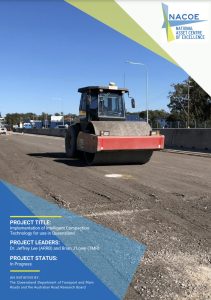
Implementation of Intelligent Compaction Technology for use in Queensland

Implementation of Intelligent Compaction Technology for use in Queensland NACOE P105 Project Summary

Categories: Research Papers

Published: 09/09/2021

This project aims to explore and facilitate the adoption of Intelligent Compaction (IC) technology in Queensland for earthworks and pavement materials.

Keywords: Intelligent Compaction

P105 Year 2 2019 2020 Implementation of Intelligent-Compaction in Queensland PSTS116 Intelligent Compaction - Earthworks and Pavements

P105 Year 2 2019 2020 Implementation of Intelligent Compaction in Queensland PSTS116 Intelligent Compaction - Earthworks and Pavements

Categories: Research Papers

Published: 17/11/2020

Intelligent compaction (IC) can provide important and immediate roller operating parameters to the operator (in the form of a visual map) to ensure that pavement layers and earthworks are compacted uniformly and in accordance with appropriate standards. IC data can also be uploaded and stored online for archiving and remote-monitoring purposes. Over the last decade, this technology has gained popularity around the world and has been shown to improve construction quality and productivity. This project commenced in the 2018–19 financial year to facilitate the implementation of IC technology in Queensland. A comprehensive literature review was undertaken during the first year to evaluate the potential benefits of such technology for the Queensland Department of Transport and Main Roads and the wider road construction industry. This report is a summary of the activities undertaken during year two (2019–20) . Year 2 focused on the development of a pilot project-specific technical specification for use in demonstration trials. The specification was successfully trialled on the Ipswich Motorway Upgrade Stage 1 (Rocklea to Darra) project. The IC technology was trialled on different materials compacted as part of the project including embankment fill, subgrade, cement modified base and unbound granular base. It was found that IC technology can readily identify soft areas in a pavement or embankment and can also be used to improve the uniformity of the compacted layers. The study showed that the Compaction Meter Value (CMV) has varying degrees of correlation against the in situ stiffness (measured by a light weight deflectometer) and conventional density results (measured by a nuclear density gauge). It was also noted that the CMV is sensitive to in situ moisture conditions during construction. It was realised early in the project that there will be significant learning required for the industry to become familiar with IC technology and to incorporate it into construction practices. Towards the end of this year’s project, the team delivered an online webinar to disseminate the results from the demonstration trial. AAPA also delivered a virtual masterclass, providing additional training on the use of the latest IC data management software, Veta 6.0. Finally, the project has funded Veta 6.0 to support the latest GDA2020 system which will soon be the main cadastral grid to be used across different jurisdictions in Australia.

Keywords: Intelligent Compaction

P105 Year 1 2018 2019 Implementation of Intelligent-Compaction in Queensland PSTS116 Intelligent Compaction - Earthworks and Pavements

P105 Year 1 2018 2019 Implementation of Intelligent Compaction in Queensland Intelligent Compaction - Earthworks and Pavements

Categories: Research Papers

Published: 27/01/2019

This report presents a literature review of the use of intelligent compaction (IC). The aim of the review was to gain the experiences and understanding of recent advances in the use of IC technology for earth fill, granular and stabilised materials. A brief summary on the background and history of IC is presented, followed by an introduction of IC instrumentation systems. The benefits and disadvantages of IC are then discussed. The main advantages of IC technology are the improvement in compaction quality and uniformity, as well as the reduction in construction and maintenance costs, including the liability costs associated with repairs and maintenance after construction The report also presents details of current IC equipment, including both original IC rollers and the retrofit kit that can be incorporated onto conventional rollers. The adopted measurement values (MVs) used by different roller vendors are presented, with the emphasis on the theory behind these measurement values to correlate measurements to the soil stiffness/modulus. A summary of existing specifications adopted in Europe and the USA is also presented, which may serve as references for the development of Australian specifications on the use of IC. A series of findings derived from previous case studies on the correlations between roller measurement values and spot tests on different soil types and underlying materials is also provided. Based on the findings obtained from the case studies and the existing specifications, the general IC in situ calibration procedure is summarised, which may be adopted as a guideline to carry out an IC trial in Queensland. Finally, preliminary recommendations are made on how IC can be incorporated into current Department of Transport and Main Roads Technical Specifications, including MRTS04, MRTS05 and MRTS07B.

Keywords: Intelligent Compaction

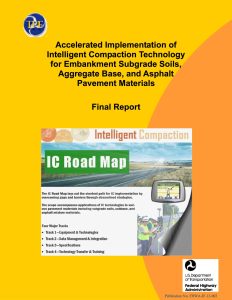
US DOT FHWA Accelerated Implementation of Intelligent Compaction Technology for Embankment Subgrade Soils, Aggregate Base, and Asphalt Pavement Materials – Final Report – July 2011

Categories: Research Papers

Published: 01/07/2011

The goals of this three year project included:

  1. Demonstration of soils/subbase and Hot Mix Asphalt (HMA) IC technologies to department of transportation (DOT) personnel, contractors, etc.,
  2. Develop an experienced and knowledgeable IC expertise base within DOT,
    Assisting DOT in the development of IC quality control (QC) specifications for the subgrade, subbase, and HMA pavement materials, and
  3. Identification and prioritization of needed improvements and further research for IC equipment and data analysis.
  4. Identification and prioritization of needed improvements and further research for IC equipment and data analysis.

Goal No. 1 was accomplished by demonstrating the abilities of the IC system such as: tracking roller passes, HMA surface temperatures, and intelligent compaction measurement values (ICMV).

Goal No. 2 was accomplished by building the IC knowledge base with extensive field experiences, data, and analysis/reports from diverse demonstration projects.

Goal No. 3 was accomplished by training DOT personnel and earthwork/paving contractors on the IC technologies via field demonstrations and open house activities. Continuous support was provided to the TPF State DOTs for the development of local, customized IC specifications during the project period.

Goal No. 4 was accomplished by compiling a comprehensive list of recommendations for the IC roller vendors to further improve their systems for widespread use of the technologies. Various IC systems were reviewed in-depth and gaps were identified for future research and engineering practices.

Keywords: Intelligent Compaction, Light Weight Deflectometer

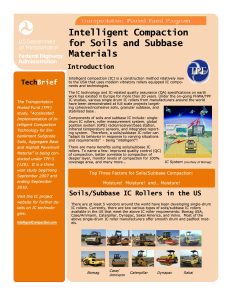
Intelligent Compaction for Soils and Subbase Materials – US DOT FHWA (US Department of Transport Federal Highway Authority) – Transportation Pooled Fund Program Summary

Categories: Research Papers

Published: 10/09/2010

Five single drum IC rollers (smooth drum and padfoot) were assessed from Bomag USA, Case/Ammann, Caterpillar, Dynapac, Sakai America, and Volvo.

For IC correlation analysis, in-situ tests are used to directly obtain the response of the compacted materials under various loading situations and drainage/moisture conditions. Recommended in-situ test devices for soils/ subbase/ stabilized IC are as followings:

  • Light Weight Deflectometer (LWD)
  • Dynamic Cone Penetrometer (DCP)
  • Calibrated Nuclear Moisture-Density Gauge for soils and subbase (NG)
  • Falling Weight Deflectometer (FWD)
  • Static Plate Loading Test (PLT)

Keywords: Intelligent Compaction, Light Weight Deflectometer, Plate Load Test

Intelligent Compaction Implementation: Research Assessment – University of Minnesota (July 2008)

Categories: Research Papers

Published: 01/07/2008

IC provides only an index, which is specific to the conditions associated with a particular site. An interpretation of comments provided the basis for the following recommendations:

  • Use light weight deflectometers (LWD) for quality assurance of stiffness
  • Establish a procedure to determine the target LWD value
  • Eliminate calibration areas (control strips)
  • Simplify IC data evaluation and presentation
  • Calibrate the IC roller and related transducers
  • Support development of alternative IC methodologies
  • Simplify or eliminate moisture corrections

Keywords: Intelligent Compaction, Light Weight Deflectometer

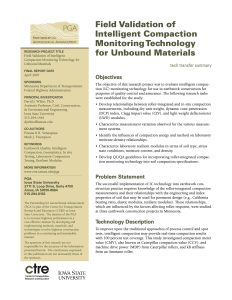
Field Validation of Intelligent Compaction Monitoring Technology for Unbound Materials – Iowa State University (2007)

Categories: Research Papers

Published: 01/04/2007

The objective of this research project was to evaluate intelligent compaction (IC) monitoring technology for use in earthwork construction for purposes of quality control and assurance. The following research tasks were established for the study:

  • Develop relationships between roller-integrated and in situ compaction measurements, including dry unit weight, dynamic cone penetration (DCP) index, Clegg impact value (CIV), and light weight deflectometer (LWD) modulus.
  • Characterize measurement variation observed for the various measure- ment systems.
    Identify the influences of compaction energy and method on laboratory moisture-density relationships.
  • Characterize laboratory resilient modulus in terms of soil type, stress state conditions, moisture content, and density.
  • Develop QC/QA guidelines for incorporating roller-integrated compac- tion monitoring technology into soil compaction specifications.

Keywords: Intelligent Compaction, Light Weight Deflectometer

Alternatives to Traditional Compaction Control Assessment – Standards and Specifications

Current earthworks specifications often rely on the assumption that there is a direct correlation between density and modulus (i.e. the greater the density achieved, the higher the modulus of the...

Bridge Approaches – Managing the High Risk Transition Zone between Flexible and Rigid Structures

A bridge approach transition zone is the area where a road or railway track transitions from the rigid structure of a bridge to the flexible embankment or road pavement, aiming...

How to Increase Compaction Uniformity and Eliminate Under and Over Rolling with Intelligent Compaction

Compaction is one of the most important processes in pavement construction and, done well, leads to long-lasting pavement performance and reduced maintenance costs. Our clients use Intelligent Compaction to create...

Check Out Insitutek’s New Ground Improvement Portfolio

We are delighted to officially announce our Ground Improvement portfolio. For the last three years, we have been working on extending our offer from, just, in situ testing to testing...

Let’s catch up at Sydney Build (Construction) or SPARC Hub (Pavements) Showcase in Melbourne

There are two events we thought you maybe interested in: Sydney Build 2023 (think of it like the Australian BAUMA trade fair) focused on Contractors, Engineers, Government & more - 6-7 March 2023 SPARC...

SPARC Hub Holds Virtual Intelligent Compaction (IC) Workshop – Learnings

The SPARC (Smart Pavements Australia Research Collaboration) Hub, led by Monash University, held a successful two-day online workshop on intelligent compaction last September 29-30. The Hub is leading the effort...

Quality Management of Earthworks with Deflection-Based Devices – 14 May 2020 Seminar

In-situ non-destructive testing (NDT) devices that estimate the stiffness parameters of a constructed pavement structure are emerging. Such stiffness parameters are more representative of the performance predicted by the mechanistic design process...

Why is there a shift from density to modulus based testing?

Have you noticed an increase in the number of questions relating to modulus based testing for soils? We certainly have. We are now wondering how soon this trend will gather...

Top 10 trends in Site Investigation and Geotechnical Testing

We find our clients are increasingly demanding more accurate and more representative results that provide better insight on what’s going on below the surface when they are designing or constructing...

Intelligent Compaction: Working Towards Achieving Compaction Uniformity – Workshop

AGS QLD, the Australian Road Research Board (ARRB) and Monash University invite you to attend the 1st workshop on Intelligent Compaction held in Australia. This highly interactive workshop will be lead...

Changing Face of Compaction & Compaction Control for Road Building

Changing Face of Compaction & Compaction Control for Road Building - A Global Review Compaction is one of the most important processes in roadway construction. A uniform base and subgrade is...

Compaction – The Building Block Of Quality Infrastructure

Compaction – The Building Block Of Quality Infrastructure Earth Mover & Civil Contractor Magazine – Compaction Feature – Jun 2015 Article on getting compaction right first time, with tools like Intelligent...

Insitutek’s Journey with Intelligent Compaction


Intelligent Compaction TxDOT-demoIn May 2018, Insitutek organised the first ever one day workshop on Intelligent Compaction in Australia; Intelligent Compaction: Working Towards Achieving Compaction Uniformity. The event attracting over 150 participants from contractors,  road authorities, industry bodies, design consultants, geotechnical testing specialists, universities and OEM roller / IC retrofit kit manufacturers and distributors.

In July 2020, the National Asset Centre of Excellence (NACoE) presented ‘Implementation of Intelligent Compaction in Queensland’. You can listen to the webinar and download the slides.

In September 2021, Insitutek’s Robin Power was an invited panelist at the SPARC International Workshop on Intelligent Compaction 2021 and chaired the final panel discussion. SPARC is the Smart Pavements Research Collaboration, led by Monash University. The SPARC Hub is providing an unprecedented opportunity for the Australian pavement industry to solve problems, innovate, advance practice and drive commercial benefits. The SPARC Hub brings together local and overseas researchers, road and other transport agencies, local councils, infrastructure managers and contractors, and material suppliers in a five-year program of research and development, training and technology transfer.

Trusted by our clients

Trusted by our partners

Insitutek Blogs