

Compaction is one of the most important processes in civil engineering projects, including bulk earthwork, foundations, backfilling, and pavements. Ensuring high-quality compaction is crucial for the resilience, long-term performance and safety of infrastructure. Uneven compaction—whether under-rolling or over-rolling—can lead to costly problems like settlement, rutting, and premature failure of roads, embankments, and foundations. Traditional compaction methods often rely on operator judgment and periodic spot testing, which can result in inconsistent compaction across the site.
Intelligent Compaction (IC) is changing that. By integrating real-time data collection, GPS tracking, and advanced sensor technology into compaction equipment, IC enables contractors to achieve consistent and optimized compaction—eliminating guesswork and significantly reducing the risk of human error.
The Problem: Under and Over Rolling
- Under-rolling leaves areas insufficiently compacted, leading to weak zones that can compromise structural integrity.
- Over-rolling wastes time and fuel, increases equipment wear, and can crush or degrade the material, especially in granular soils or thin lifts. Over-compaction can also result in the need for additional material to meet final surface levels, leading to significant and often unforeseen project costs.
Both issues can lead to rework, project delays, and maintenance headaches.
What Is Intelligent Compaction?
Intelligent Compaction (IC) or Continuous Compaction Control (CCC) refers to the compaction of pavement materials, such as granular soils, cohesive soils, aggregate bases and subbase and asphalt, using vibratory rollers equipped with an integrated stiffness measurement system, an onboard computer reporting system and Global Positioning System (GPS) based mapping. Asphalt temperature can also be assessed.
The Völkel Navigator Intelligent Compaction system can be retro-fitted to most rollers, regardless of manufacturer. We also use it for Impact Rolling. Its capabilities include:
- Pass count tracking
- Pavement response (an indication of stiffness)
- Temperature measurement for asphalt
- QC and QA reporting


How the Völkel Navigator Prevents Under- or Over-Compaction
- Captures on-the-fly real time feedback for the operator and a continuous record of the compaction process with colour-coded plots
- Provides real-time data synchronisation between rollers, giving all operators a unified, live view of compaction progress—such as pass counts and stiffness—enabling a complete, synchronised picture of the site’s status directly on their cab displays.
- Measures compaction uniformity and provides 100% coverage – overcoming the issues with a limited number of spot tests for Quality Assurance (QA) purposes
- Detect soft spots and anomalies
- Gamifies the operators work environment, empowering them by enabling them to deliver better compaction outcomes
- Accelerates operator skill development by providing visual feedback.
To calibrate the material stiffness measurements, Light Weight Deflectometer and Plate Load Test in situ testing methods are typically used.
Blind Trial Case Study – Demonstrating Improved Rolling Pattern
By covering over the roller operators in-cab display, we can create a blind test.
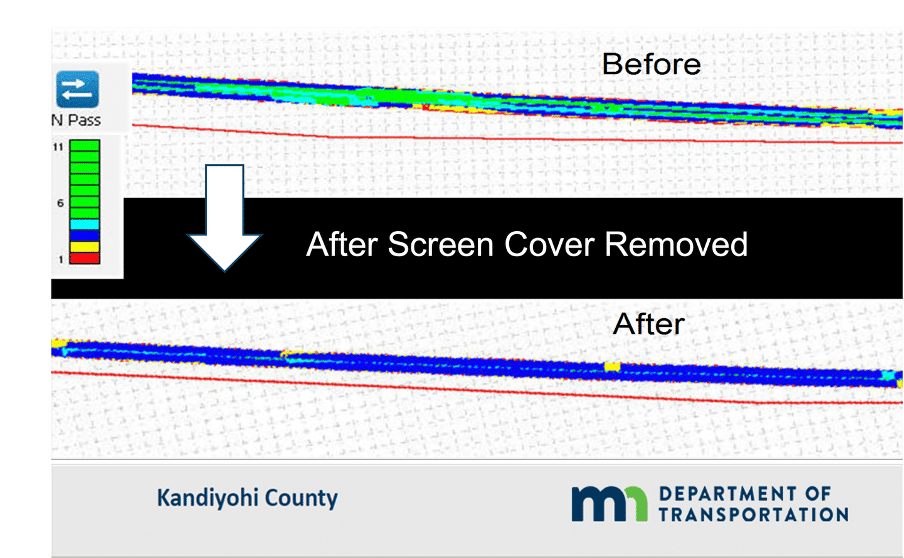
Before – this experienced roller operator had never used Intelligent Compaction before and did their best to deliver three passes. This clearly shows over- and under-rolling.
After – the screen cover was removed and the roller operator was asked to deliver three passes.
The contrast is stark and typical of our experiences with such blind tests. Over-rolling by 30% or more is typical.
For more insights and case studies on “Intelligent Compaction – Reducing Over & Under – Compaction & Increasing Compaction Uniformity“, you can review a technical paper presented at 20th AfPA International Conference 2025 | Future Ready Roads co-authored by our Chief Executive, Robin Power.
If you are working with soils, using Völkel Navigator Intelligent Compaction system in combination with the PANDA Instrumented DCP and Light Weight Deflectometer, there is potential to increase layer lift thicknesses with confidence. This is a construction game changer, helping to increase rates of construction, lower cost, improve quality, reduce risk and reduce your environmental impact.
If you want to benefit from this exceptionally easy to use valuable technology, let’s have a conversation.


