- Non-destructive rail track ballast assessment (ballast fouling & ballast recovery rates) and condition monitoring of the formation (rail track substructure layers)
- PANDOSCOPE® is a coupling of tip resistance vs depth profile with very high quality down the hole imagery
- Particle Size Distribution (PSD) & moisture content
- Used for planning rail track maintenance and renewal programs
- PANDOSCOPE® testing is used to provide more information in problem areas and to calibrate Ground Penetrating Radar (GPR) data
PANDOSCOPE® for Rail Ballast & Formation Condition Assessment
Applications
Our focus is providing the highest value geotechnical insights related to track performance and stability, enabling data based decision making, supported with video and imagery in GIS and physical context to empower the track designers, site engineers and construction managers. Our objective is to drive best value engineering outcomes and to identify optimisation (e.g. material, time and financial saving) opportunities for rail rehabilitation and renewal works.
In rail applications, the PANDOSCOPE® measures geotechnical aspects of the track bed and can provide the following outcomes:
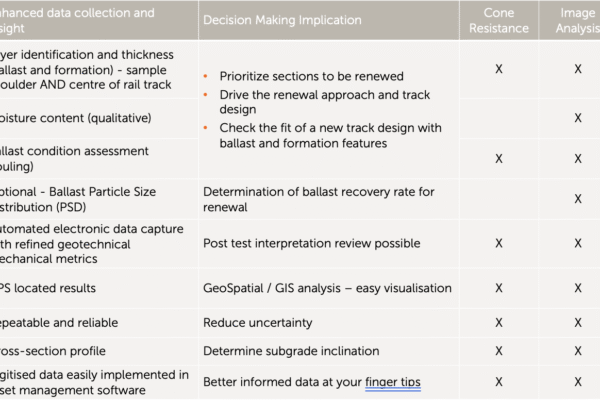
- Layer characterisation for ballast and formation (identification, thickness, water content (qualitative), estimation of the ballast Particle Size Distribution (PSD) and ballast condition (ballast fouling) assessment
- Mechanical information: cone resistance (direct measurement) or CBR or other parameters with correlations
- Sometimes, we combine PANDOSCOPE® testing with Ground Penetrating Radar (GPR) data collection over the whole line. In simple terms, the GPR helps us pinpoint where to look in more detail and the PANDOSCOPE® provides the additional detail vital for track design purposes. This provide a versatile diagnostic approach for pseudo-continuous condition assessment of subgrade, rail formation, sub-ballast capping and ballast layers. Ground Penetrating Radar (GPR) is a non-intrusive geophysical method that uses radar pulses to create a continuous profiling image of the subsurface. It is a method of surveying that provides continuous input data for track profile studies, in particular the depth of the various railway base layers.
The PANDOSCOPE® data helps rail asset managers / infrastructure managers optimise the track maintenance and track renewal strategy by prioritising and allocating rehabilitation efforts and funding only to the sections that require priority attention whilst minimizing track downtime. Their objectives maybe:
- Maintain the current usage requirements
- Accommodate increases in safety, train frequency, speed and load
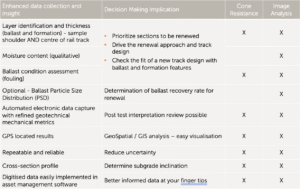
The PANDOSCOPE® provides engineering services with reliable geotechnical data for track design purposes. The knowledge of mechanical and physical properties of existing formation (subgrade and sub ballast layers) is very important for the future track design.
The maintenance costs of ballasted tracks can be significantly reduced if an accurate estimation of the different types and degree of ballast fouling can be related to track drainage.
The results of these investigations, as well as the topographical and arrow surveys, enable the design engineers to dimension the track to be renewed and its layout (type of sleeper, ballast thickness, geotextile requirements, ballast cleaning, etc.) and for these rehabilitations works then to be costed and planned.
Here are some of the research papers on the PANDOSCOPE® technology rail applications.
Advantages
The PANDOSCOPE® overcomes the limitations of the majority of classical geotechnical tests (drilling rigs, pot holing). Benefits include:
- Proven approach
- Tried and tested investigation strategy for track maintenance and renewal (localised or cross network)
- Stand alone PANDOSCOPY or the coupled use of PANDOSCOPY and GPR
- Several thousand kilometres of investigations over 150,000 tests
- Passenger and heavy haul freight networks
- Several countries including France, UK, Netherlands, Belgium, USA, Canada, Singapore, Chile and Australia
- No destabilisation / disturbance of the track
- Important if renewal works are delayed or do not proceed
- Granulometry using PANDOSCOPE® imagery avoids the need for ballast sampling (non-traumatic control) and eliminates the subjectivity of sampling
- Better informed decision making
- Speed and versatility
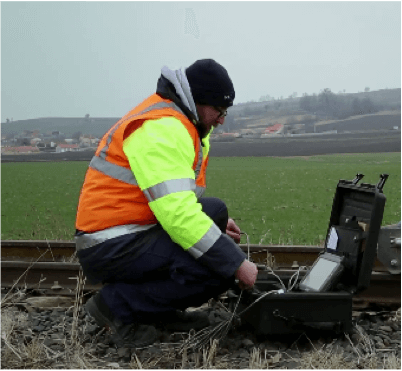
- Easy/fast set-up on and off the track. Limited track possession time required (e.g. can test between trains working under lookout protection)
- Light weight portable equipment enables track access onto embankments and into cuttings – no plant on track
- 2 people
- PANDA® : 20 kg
- Geo-endoscope : 10kg
- Equipment fits in backpacks
- No need to shut down the overhead power e.g. due to the height of sampling equipment due
- Cost effective methodology
- Reduced cost per hole compared to conventional approaches like potholing
- Reduced head count on site
- Less flights/accommodation required for remote site working
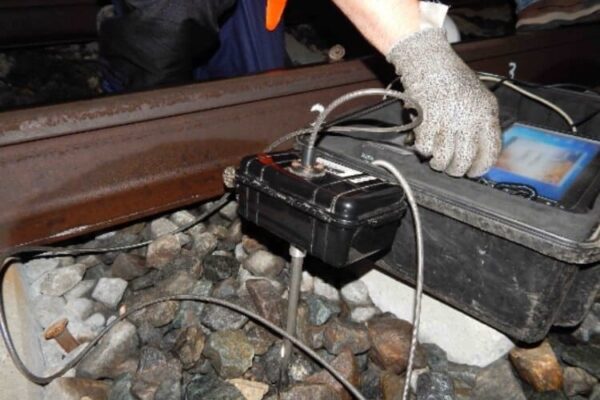
The PANDA® Instrumented Dyamic Cone Penetrometer (DCP) involves driving a variable energy cone penetration device into the rail track substructure to collect the strength (and modulus by correlation) profile with depth. Condition monitoring of the rail track substructure layers is accomplished through insertion of a camera into the same hole, also called Geoendoscopy. The combined system is referred to as the PANDOSCOPE®. The PANDA®, PANDOSCOPE® and Geoendoscopy are all systems developed by Sol Solution.
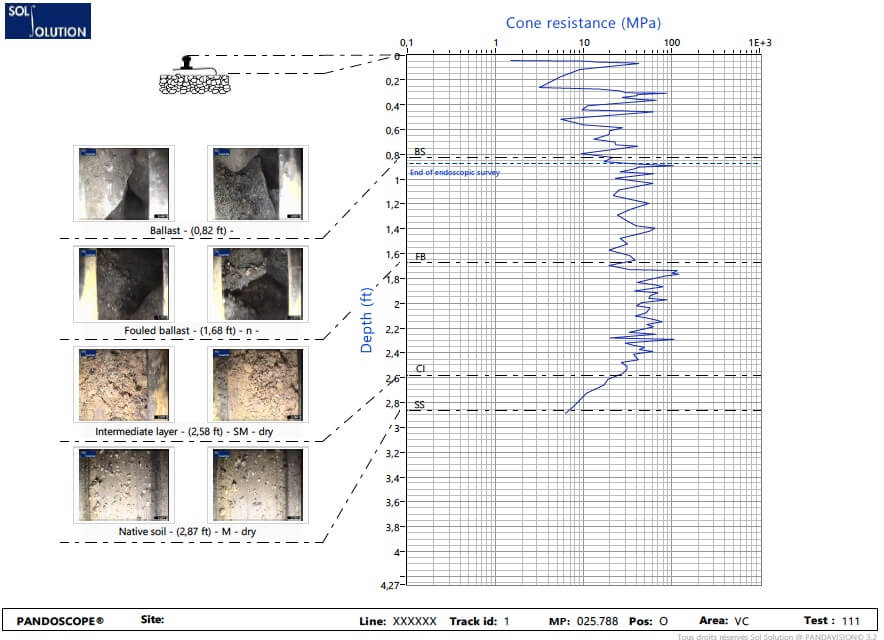
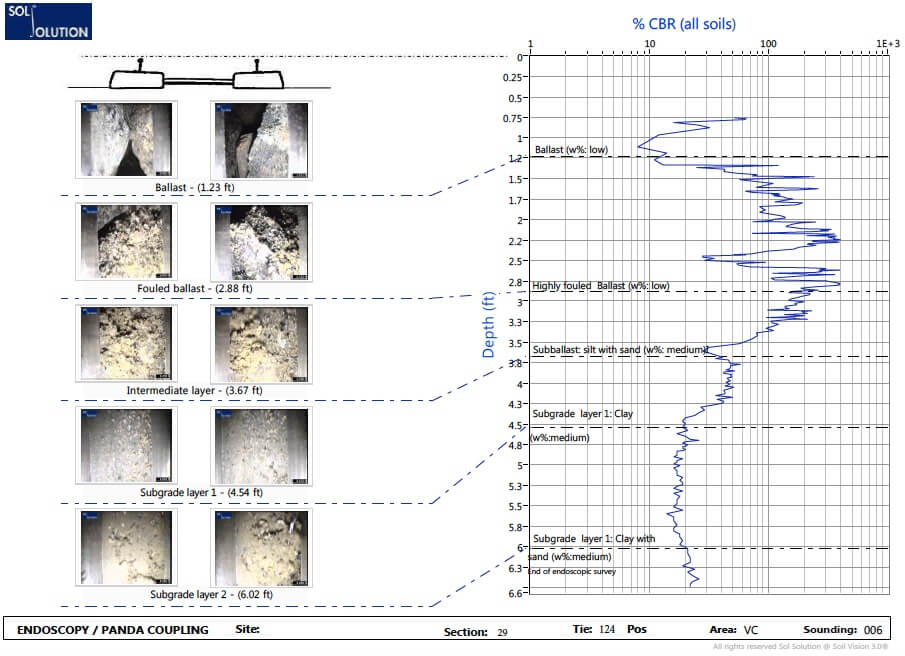
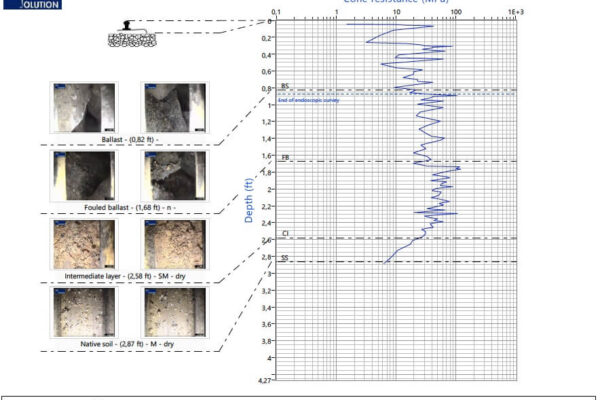
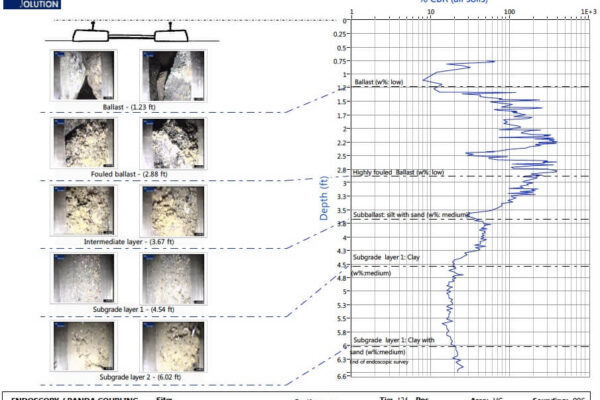
Once the PANDOSCOPE® data has been processed, the results can be presented.
The main functions of railway ballast are:
- to provide high load bearing capacity which reduces pressure from the sleeper bearing area to acceptable levels at the surface of the subgrade soil
- to provide rapid drainage
Rail ballast usually contains uniformly graded large, angular particles of typical size ranging between 25 and 50 mm, creating a sufficiently large pore structure to facilitate rapid (free) drainage. When ballast is aged and degraded, fine particles accumulate within the voids (fouling) thus impeding drainage. The process of ballast fouling, when it becomes extreme, can also generate excess pore water pressure under fast moving trains (i.e., high cyclic loading), thereby reducing the track resiliency and stability (undrained).
To find out more, Contact Us.

Products
Related Solutions
The PANDOSCOPE® is a coupling of the PANDA® Instrumented Dynamic Cone Penetrometer (DCP) (tip resistance vs depth profile) and Geoendoscopy (imagery from down boreholes) combined with sophisticated data presentation and analysis software.
The PANDA® Instrumented Dyamic Cone Penetrometer (DCP) involves driving a variable energy cone penetration device into the rail track substructure to collect the strength (and modulus by correlation) profile with depth. Condition monitoring of the rail track substructure layers is accomplished through insertion of a camera into the same hole, also called Geoendoscopy. The combined system is referred to as the PANDOSCOPE®. The PANDA®, PANDOSCOPE® and Geoendoscopy are all systems developed by Sol Solution.

Once the PANDOSCOPE® data has been processed, the results can be presented.
The right hand chart shows the Penetrogram of the PANDA® cone resistance according to depth. The left hand window shows the stratigraphy of the track layers (thickness, nature and hydrous state). The degree of ballast fouling is clearly visible, even if there if there is no distinct interface between clean and fouled ballast.

PANDA® Instrumented Dynamic Cone Penetrometer (DCP)
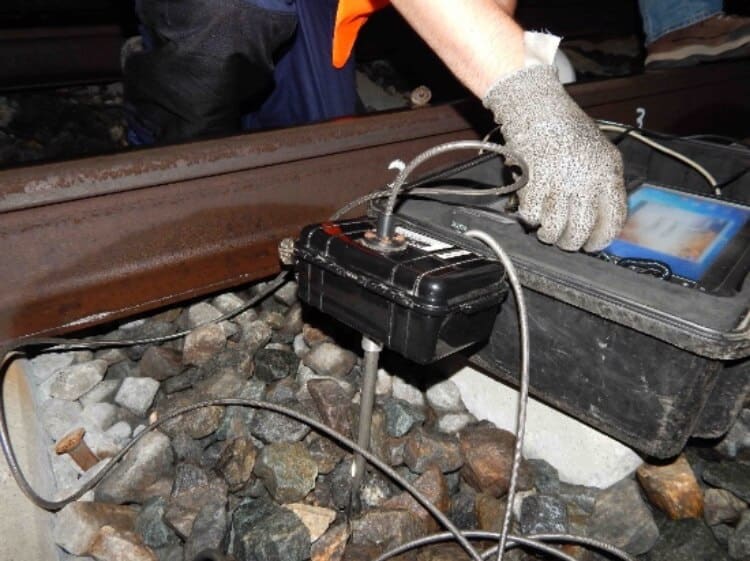
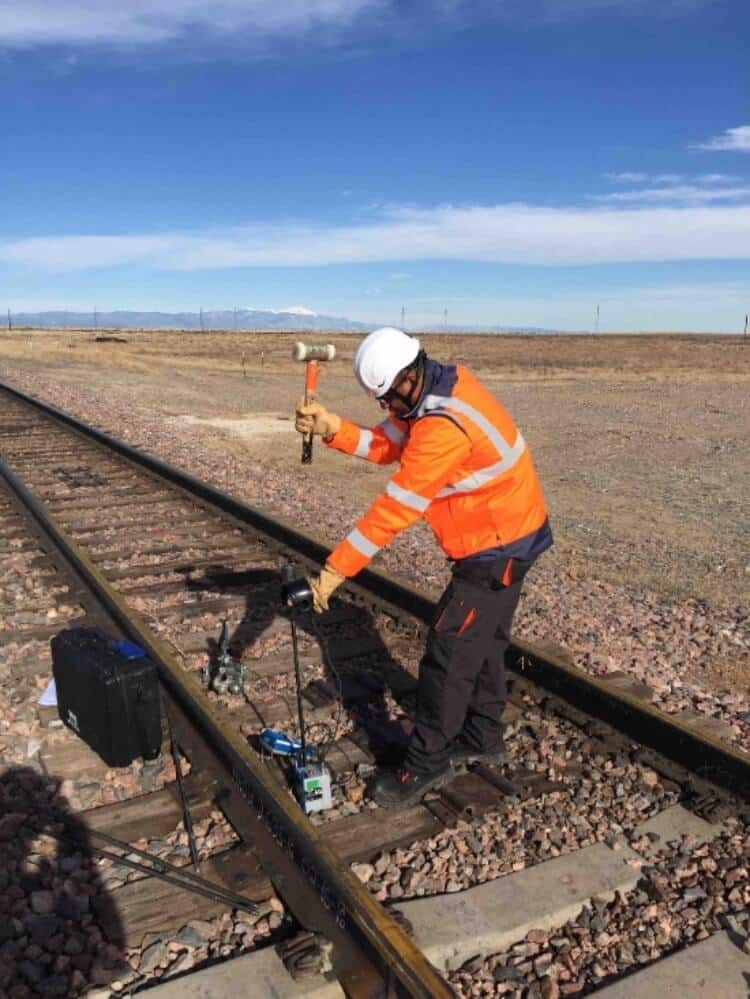
The PANDA® test is an instrumented variable energy dynamic penetration test. The tests consists of driving a set of steel rods equipped with a conical tip of 2cm2 cross-section through the material by hammering an Anvil with a standardised hammer. At each hammer blow, the energy is measured in the anvil with strain gauges.
Sensors measure simultaneously the settlement or vertical displacement of the cone. All the data is transmitted to the Central Acquisition Unit. The results are displayed immediately on the Dialogue Terminal as penetrograms, graphs that show the evolution of cone resistance according to depth.
For each blow, the depth of penetration and the driving variable energy are measured to calculate the dynamic cone resistance (qd) with the corresponding depth using the Dutch Formula, shown in this figure.
 A is the cross-sectional area of the cone
- E is the kinetic energy fed into the system during the impact
- e is the penetration per blow
- P is the weight of the driven parts during impact (impact head/anvil, rods and tip)
- M is the weight of the striking hammer
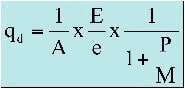 A is the cross-sectional area of the cone
The PANDA® collects mechanical information including cone resistance (direct measurement) or CBR or other parameters with correlations. This is presented in graphical format, knows as a penetrogram.
The PANDA® is a versatile equipment with a total weight less than 20 Kg. Within the framework of the railway use, adaptations have been made to make it even lighter and tougher.
Geoendoscopy
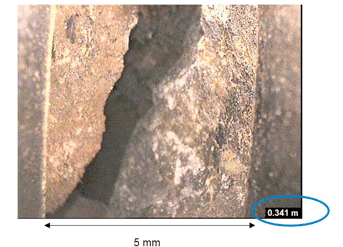
The Geoendoscopy test uses a tiny very high quality video camera (wired to a data logger with a soft cable) to observe the soil. The camera is introduced into the hole of a previously performed PANDA® DCP test (15 mm of diameter). The collection of imagery from down the hole allows a qualitative characterisation of soil.
It enables condition monitoring of the railway track substructure layers. The layer characterisation for ballast and subgrade includes layer identification, layer thickness, water content (qualitative), condition (ballast fouling) and even the estimation of the soil grain size distribution (Granulometry).

-
Adapting Innovative Tracked Investigation Technique for the UK Niall Fagan, Younes Haddani & Amine Dhemaied Railway Engineering 2025
Categories: Research Papers
Topics: Rail
Published: 10/06/2025
The need for better asset condition data is driving change within the UK rail industry in terms of embracing new technology. With good quantitative data, we can better analyse asset condition and deterioration rates which will improve decision making on maintenance interventions and track renewals specifications. This is particularly true for track bed investigations. The Pandoscope is a simple and quick non-intrusive test that produces quantitative data to make site specific decisions. It can replace the time-consuming trial holes and the automatic ballast sampler, generally used in the UK. A case study is described in this paper to highlight the difference in approaches between the UK and France. The outputs of both methods are compared and the benefits of using the Pandoscope are demonstrated by a reduced track bed specification. Finally, proposals are made with the quantitative outputs with limits for potential changes to Network Rail standards.
KEYWORDS: Track bed investigation, sub-ballast layers, data-driven decisions, quantitative data
Keywords: Ballast & Formation Condition Assessment, PANDA® Instrumented DCP, PANDOSCOPE
On site fouling index assessment of ballasted layers using cone dynamic penetrometer and miniature borescope image analysis - Vivanco, Breul, Talon, Benz-Navarrete, Barbier & Ranvier 2024
Categories: Research Papers
Topics: Rail
Published: 15/02/2024
Ballast characterization is a fundamental task to optimize decision-making in maintenance or renewal programs of railway tracks. For that purpose, be able to evaluate the fouling and the deterioration of the ballast are the major problem. This study aims to characterize the fouled ballast using a Lightweight dynamic cone penetrometer (LDCP) and g´ eoendoscope test. The methodology presented consists in analyzing the resistance properties of the ballast layer by means of dynamic cone resistance (qd) and then performing a geoendoscopy test to obtain borehole images for the material characterization. Statistical analysis of cone resistance and statistical image parameters (texture and colometry) shows their dependence on the degree of fouling as well as on its nature. As ballast fouling increases, the average cone resistance initially increases and then decreases. Images features also depend on the proportion of fouling but especially allow to distinguish different contents of fine particles in the fouling material. However, each of the measurements taken separately is not sufficient to determine a ballast fouling amount. The final results indicate that the method can accurately determine the fouling index with minimal variations.
Keywords: Laboratory test, Penetrometer, Geoendoscopy, Railway, Ballasted track, Fouling Index, Statistical analysis, Data fusion, Grain size
Keywords: Ballast & Formation Condition Assessment, PANDA® Instrumented DCP, PANDOSCOPE
PANDOSCOPE Ballast Fouling and Rail Track Formation Profile Brochure
Categories: Brochures
Published: 01/06/2022
Keywords: Ballast & Formation Condition Assessment
Ground Penetrating Radar (GPR) Technology Evaluation and Implementation - Appendix A-F Federal Railroad Administration 2020
Categories: Research Papers
Topics: Rail
Published: 22/05/2020
Keywords: Ballast & Formation Condition Assessment, PANDA® Instrumented DCP, PANDOSCOPE
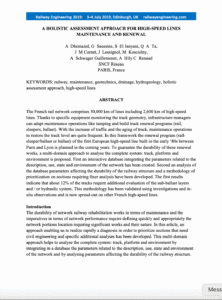
A holistic assessment approach for High Speed Lines Maintenance and Renewal - SNCF - Railway Engineering 2019
Categories: Research Papers
Topics: Rail
Published: 04/07/2019
The French rail network comprises 30,000 km of lines including 2,600 km of high-speed lines. Thanks to specific equipment monitoring the track geometry, infrastructure managers can adapt maintenance operations like tamping and build track renewal programs (rail, sleepers, ballast). With the increase of traffic and the aging of track, maintenance operations to restore the track level are quite frequent. In this framework the renewal program (rail-sleeper/ballast or ballast) of the first European high-speed line built in the early ‘80s between Paris and Lyon is planned in the coming years. To guarantee the durability of these renewal works, a multi-domain approach to analyse the complete system: track, platform and environment is proposed. First an interactive database integrating the parameters related to the description, use, state and environment of the network has been created. Second an analysis of the database parameters affecting the durability of the railway structure and a methodology of prioritization on sections requiring finer analysis have been developed. The first results indicate that about 12% of the tracks require additional evaluation of the sub-ballast layers and / or hydraulic system. This methodology has been validated using investigations and in-situ observations and is now spread-out on other French high-speed lines.
KEYWORDS: railway, maintenance, geotechnics, drainage, hydrogeology, holistic, assessment approach, high-speed lines
Keywords: Ballast & Formation Condition Assessment, PANDA® Instrumented DCP, PANDOSCOPE

Statistical analysis of cone penetration resistance of railway ballast - Gilles Saussine, Amine Dhemaied, Quentin Delforge and Selim Benfeddoul SNCF Réseau 2017
Categories: Research Papers
Topics: Rail
Published: 01/06/2017
Dynamic penetrometer tests are widely used in geotechnical studies for soils characterization but their implementation tends to be difficult. The light penetrometer test is able to give information about a cone resistance useful in the field of geotechnics and recently validated as a parameter for the case of coarse granular materials. In order to characterize directly the railway ballast on track and sublayers of ballast, a huge test campaign has been carried out for more than 5 years in order to build up a database composed of 19,000 penetration tests including endoscopic video record on the French railway network. The main objective of this work is to give a first statistical analysis of cone resistance in the coarse granular layer which represents a major component of railway track: the ballast. The results show that the cone resistance (qd) increases with depth and presents strong variations corresponding to layers of different natures identified using the endoscopic records. In the first zone corresponding to the top 30cm, (qd) increases linearly with a slope of around 1MPa/cm for fresh ballast and fouled ballast. In the second zone below 30cm deep, (qd) increases more slowly with a slope of around 0,3MPa/cm and decreases below 50cm. These results show that there is no clear difference between fresh and fouled ballast. Hence, the (qd) sensitivity is important and increases with depth. The (qd) distribution for a set of tests does not follow a normal distribution. In the upper 30cm layer of ballast of track, data statistical treatment shows that train load and speed do not have any significant impact on the (qd) distribution for clean ballast; they increase by 50% the average value of (qd) for fouled ballast and increase the thickness as well. Below the 30cm upper layer, train load and speed have a clear impact on the (qd) distribution.
Keywords: Ballast & Formation Condition Assessment, PANDA® Instrumented DCP, PANDOSCOPE
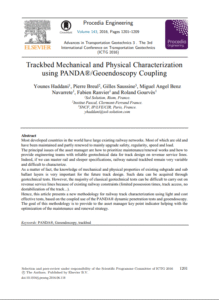
Trackbed Mechanical and Physical Characterization using PANDA Geoendoscopy Coupling - Younes Haddani, Pierre Breul, Gilles Saussine, Miguel Angel Benz Navarrete, Fabien Ranvier and Roland Gourvès (2016)
Categories: Research Papers
Topics: Rail
Published: 01/01/2016
The principal issues of the asset manager are how to prioritize maintenance/renewal works and how to provide engineering teams with reliable geotechnical data for track design on revenue service lines. Indeed, if we can master rail and sleeper specifications, railway natural trackbed remain very variable and difficult to characterize.
As a matter of fact, the knowledge of mechanical and physical properties of existing subgrade and sub ballast layers is very important for the future track design. Such data can be acquired through geotechnical tests. However, the majority of classical geotechnical tests can be difficult to carry out on revenue service lines because of existing railway constraints (limited possession times, track access, no destabilization of the track…).
Hence, this article presents a new methodology for railway track characterization using light and cost effective tests, based on the coupled use of the PANDA® dynamic penetration tests and geoendoscopy. The goal of this methodology is to provide to the asset manager key point indicator helping with the optimization of the maintenance and renewal strategy
Keywords: Ballast & Formation Condition Assessment, PANDA® Instrumented DCP, PANDOSCOPE
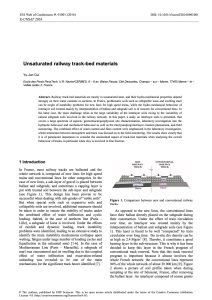
Unsaturated-Railway-Track-bed-Materials-Yu-Jun-Cui-2016.pdf
Categories: Research Papers
Topics: Rail
Published: 01/01/2016
Keywords: Ballast & Formation Condition Assessment, PANDA® Instrumented DCP, PANDOSCOPE

Railway Ballast Settlement - A New Predictive Model - Saussine, Quezada, Breul and Radjai - Second International Conference on Railway Technology - 2014
Categories: Research Papers
Topics: Rail
Published: 02/06/2014
By means of a detailed parametric study of the settlement of ballast material performed on a full-scale track model, a predicting model for ballast settlement under cyclic loading has been developed. The model is based on track parameters: axle load, train speed and the initial mechanical state of ballast. A light dynamic penetrometer allows the characterization of the latter. Several loading tests, were performed, together with a characterization of the initial state of ballast close to the sleepers. Three hundred and sixty curves of settlement were obtained. The results show a settlement evolution in three stages (short, medium and long term settlement) depending on the initial conditions of the material and the intensity of the vibration. The settlement models reviewed in literature (Shenton, Hettler or Tom and Okley model) are not able to describe the entire evolution of the settlement curves. By developing a model based on the Chicago’s density relaxation law, it is possible to estimate the evolution of settlement from the loading parameters and the initial mechanical state of the ballast material. From the database and studies of the Chicago experiments two governing parameters, can be identified, which represent the intensity of loading and cone resistance in coarse granular material. From these parameters it is possible to identify three functions which give the three parameters of the proposed model of the settlement. The proposed model describes the three stages in the settlement evolution. This model, si selected, for the results obtained in the global analysis of error by the MSE method. With this model, we obtain a prediction of settlement evolution with an error less than 10% for almost all experimental data. As a conclusion a method is proposed which has been tested on a track and which allows one to estimate the settlement of the sleepers by considering train traffic and cone penetration resistance in order to obtain an average settlement curve and a probability to reach a threshold value. This is a first step towards a general framework for the evaluation of the geometric potential degradation of railway tracks, which is a major issue for the cost reduction of maintenance operations on railway tracks.
Keywords: ballast settlement, full-scale track model, settlement model, light penetrometer test.
Keywords: Ballast & Formation Condition Assessment, PANDA® Instrumented DCP, PANDOSCOPE
Field Ballast Granulometry Assessment Thanks to Image Analysis - Y. Haddani, G. Saussine, R. Gourvès - Railway Track Science and Engineering 2013
Categories: Research Papers
Topics: Rail
Published: 10/12/2013
Keywords: Ballast & Formation Condition Assessment, PANDA® Instrumented DCP, PANDOSCOPE
Railroad Subgrade Support and Performance Indicators – Research Report KTC-12-02/FR136-04-6F – Michael Henry & Jerry Rose – University of Kentucky
Categories: Research Papers
Topics: Rail
Published: 01/02/2012
The subgrade is an integral component of the track structure and its performance properties must be considered in order to effectively assess its influence on subsequent track quality. European and Asian railways are particularly advanced in implementing subgrade performance indicators into their track designs and assessments. As train speed and tonnage increase in the U.S., the evaluation and influence of subgrade performance will become even more paramount.
There are numerous means of measuring and predicting subgrade performance. Both laboratory and in-situ test methods have been used. A review of available testing methods is presented herein in the context of railroad subgrade assessment. Discussion on the applicability of each test to the American railroad industry is also included. In-situ tests likely provide the greater advantage in railway engineering because results can typically be obtained quickly, more cost effectively, and with a larger data set. Newer rail-bound, continuous testing devices, while not testing the subgrade directly, are extremely convenient and will likely become more common in the future.
Keywords: Ballast & Formation Condition Assessment, PANDA® Instrumented DCP, PANDOSCOPE
On Site Mechanical Characterization of the Ballast State – Pierre Breul & Gilles Saussine (2010)
Categories: Research Papers
Topics: Rail
Published: 08/12/2010
Ballast is a major railway component whose behaviour is still not sufficiently controlled. The identification of mechanisms leading to track ageing is difficult to achieve as the process occurs over several years at particle scale.
Models have been proposed to take into account ballast characteristics and provide a description of geometrical and structural modifications of ballast particles through time. To be relevant, these models must be supplied with reliable and realistic input data such as on-site density and stiffness modulus.
This article presents results that could provide these parameters, starting with on-site tests that link them with cone penetration energy.
Keywords: PANDA® Instrumented DCP
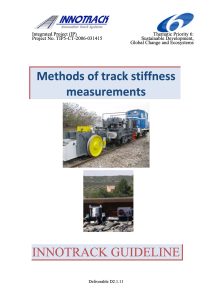
Methods of Track Stiffness Measurements – INNOTRACK GUIDELINE – Project No. TIP5-CT-2006-031415 (2006)
Categories: Research Papers
Topics: Rail
Published: 01/01/2006
Vertical track stiffness is an important parameter in railway track engineering, both from a design and maintenance point of view. This guideline presents important aspects of track stiffness as well as different measurement methods to gather stiffness information of the track.
A method called Panda, for determining local track stiffness has been used and developed. Panda is a lightweight penetrometer which determines the cone-resistance of the layers of the track substructure rapidly.
Keywords: Ballast & Formation Condition Assessment, PANDA® Instrumented DCP, PANDOSCOPE
Importance of geotechnical diagnosis in railway management - a review
Categories: Research Papers
Topics: Rail
Railway tracks, like all civil works, experience degradation after being put into service, thus losing their initial design conditions. This degradation manifests itself mainly through misalignment and specific deterioration mechanisms of each component, which reduces safety and comfort during the passage of trains. In order to maintain their operational capabilities or prolong their service life, continuous monitoring, diagnosis and maintenance processes are carried out. These actions aim to restore the physical, mechanical and geometrical properties necessary for track operation.
In practice, rail managers often employ hegemonic techniques such as geometric measurements to detect defects and routine maintenance to realign, known as tamping. Although these practices have proven to be effective, in some cases they do not technically and economically competently solve the root problem. For this reason, diagnosis should be multidisciplinary and incorporate various disciplines associated with the track components.
This paper aims to highlight the importance and impact of geotechnical diagnosis in the management of railway networks. To achieve this, the Article has the following structure: (a) Railway track components: the main elements of the track are described and the role of geotechnical components in the stability of the infrastructure is highlighted, (b) Track degradation: The main deterioration of the track, such as loss of geometry, and its relation to the wear of the geotechnical elements are addressed, (c) Monitoring and monitoring: the most commonly used geotechnical inspection methods and their effectiveness in the analysis of granular material are presented, (d) Geotechnical diagnosis: Current maintenance management is analyzed and guidelines for a comprehensive diagnosis are suggested, highlighting cases where poor assessment has generated problems, (e) Maintenance techniques: Preservation methods are reviewed, stressing the importance of accurate diagnosis for their effectiveness, and (f) Future perspectives: Trends such as the use of artificial intelligence and advanced data management in the railway sector are explored.
https://www.sciencedirect.com/science/article/pii/S2666691X24000678?via%3Dihub
Keywords: PANDOSCOPE
Insitutek
PANDOSCOPE Implementation Partner Training – STATS and 4DG – Rail Applications
Insitu Test recently completed PANDOSCOPE® training for our WA Implementation Partners, STATS Australia and 4DGeotechnics. The PANDOSCOPE® is a coupling of the PANDA® Instrumented Dynamic Cone Penetrometer (DCP) (tip resistance...
Compaction Control
Harsh Pilbara heavy haul rail conditions puts PANDOSCOPE® to the test
There is nothing like jumping in at the deep end! With buy in from Fortescue Metals Group, BHP and Rio Tinto, we brought together our supply partner, Sol Solution from France, and the...
Asphalt Pavement Investigation
Top 10 trends in Site Investigation and Geotechnical Testing
We find our clients are increasingly demanding more accurate and more representative results that provide better insight on what’s going on below the surface when they are designing or constructing...
Civil Construction
Railway track characterization with coupled use of PANDA® DCP and Geo-endoscopy – a new technique
The PANDOSCOPE® is a ‘new' non-destructive method of railway ballast condition assessment, which uses light and cost effective tests, based on the coupled use of the PANDA® dynamic cone penetrometer (a sophisticated DCP)...
Trusted by our clients





















































































































Trusted by our partners