- Determine localised seismic response
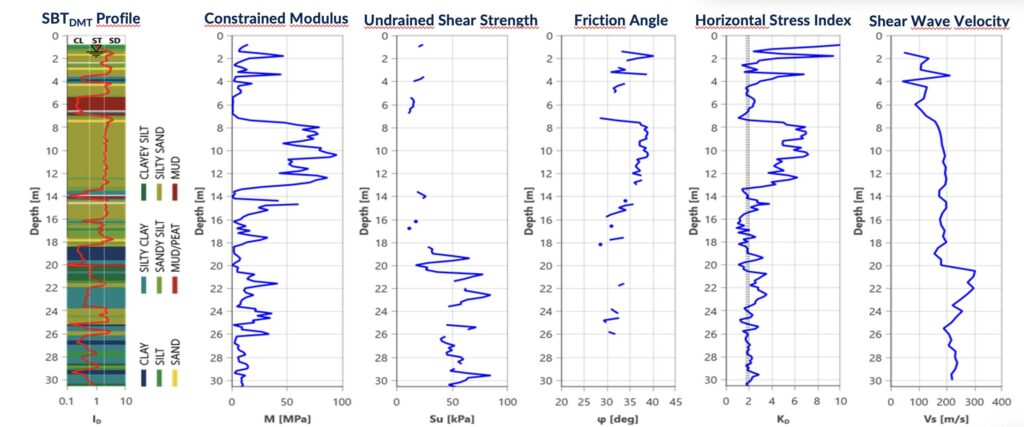
- Capture all DMT parameters + S waves + P waves
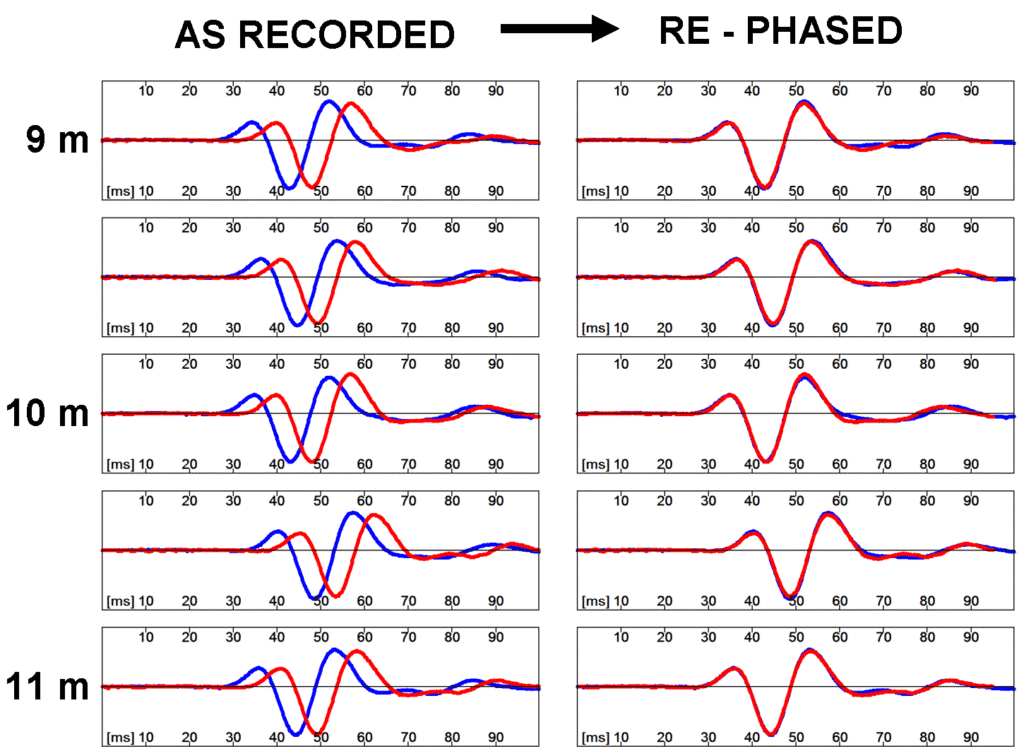
- For determining S waves, no post processing is required
- Rapid, reliable and simple technology
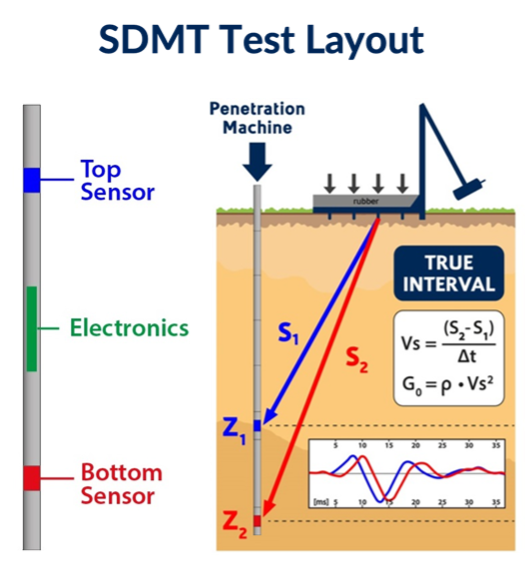
The Seismic Dilatometer (SDMT) allows both DMT and seismic tests to be performed during the same sounding. The Seismic Dilatometer (SDMT) is the combination of a dilatometer blade with an add-on tubular element equipped with additional sensors for recording Shear wave (S wave) velocity Vs and compression Primary waves (P waves).
The test can be executed in soils from semiliquid to soft rock, composed of soil grains small compared with the membrane diameter (60 mm).
The test provides accurate and repeatable results with a rapid, reliable and simple technology which does not require any geophysical background.
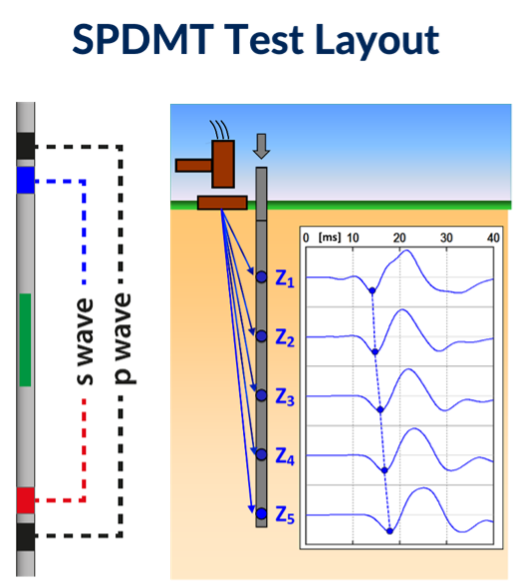
For S waves, the true interval configuration is implemented with two sensors spaced 0.5 m apart with testing recommended every 0.5 m. The high quality of the acquired seismograms enables real time shear wave velocity (Vs) evaluation. For determining S waves, typically, no post processing is required.
For P waves, the true interval configuration is implemented with two sensors spaced 0.6 m apart with testing recommended every 1 -2 m. The high quality of the acquired seismograms enables shear wave velocity (Vp) evaluation with post processing.
Accelerometers monitor the inclination of the SDMT probe during penetration.
The Seismic SPDMT Pneumatic is fully watertight and is designed for rapid interchangeability enabling the DMT blade to be swapped with a dummy cone in a matter of seconds on site. To maximize soil penetrability, the Seismic SPDMT Pneumatic body has been limited to 42 mm diameter.
The main seismic applications include:
- Maximum Shear Modulus Go
- In situ G-gamma decay curve
- Sample Quality Assessment
- Local Seismic Response
- Soil category (Vs30)
Learn more about how it works, the obtainable geotechnical parameters and their applications.
The Seismic Dilatometer (SDMT) adheres to:
- ASTM D7400/D7400M-26 Standard Test Methods for Downhole Seismic Testing
- Eurocode 7 (1997) “Standard Test Method”, European Committee for Standardization, Geotechnical design – Part 3: Design assisted by field testing, Section 9: Flat dilatometer test (DMT)
- CEN ISO TS 22476-11 (2017) “Geotechnical Investigation and Testing – Field Testing – Flat Dilatometer Test”, Part 11
To find out more, Contact Us.
Products
Related Solutions
-
Applications and Recent Developments of the Flat Dilatometer (DMT) and Seismic Dilatometer (SDMT) D. Marchetti ECSMGE Reykjavik 2019
Categories: Research Papers
Published: 10/09/2019
The Flat Dilatometer (DMT) is a direct push soil testing device developed in Italy in the late seventies. The in situ measurement of a modulus and the capability of estimating stress history have made it a widely used tool for several geotechnical applications, in particular for settlement prediction, compaction control and liquefaction resistance. Potentiated with the release of its seismic version, the Seismic Dilatometer (SDMT) provides, in addition to the standard DMT parameters, also the shear and compression wave velocities Vs and Vp. The instrument is coded in the international standards (ASTM, ISO), building codes (Eurocode7) and guideline documents (TC16 2001) and is currently used in over 70 countries.
Recent developments of a seabed system (Seafloor DMT) and of a self-contained automated dilatometer probe (Medusa DMT) are presented.
Keywords: DMT, Dilatometer; SDMT; Automated Dilatometer; Medusa
Keywords: Dilatometer Marchetti Test - DMT
Estimated Versus Measured Vs Profiles and V30 at a pilot site in the Lower Tagus Valley, Portugal C Ferreira, A Fonesca, C Ramos, S Amoroso & L Minarelli Euarthquake Engineering Thessaloniki 2018
Categories: Research Papers
Published: 26/06/2018
A pilot site in the Lower Tagus Valley near Lisbon, in Portugal has recently been set-up for liquefaction susceptibility analysis and microzonation, within the scope of the European H2020 LIQUEFACT research project. A comprehensive geological, geophysical and geotechnical site investigation campaign has been carefully carried out, including SPT, CPTu, SDMT and geophysical methods, as well as high-quality soil sampling for laboratory characterization. The geophysical tests comprised seismic refraction, SASW and borehole seismic tests (SDMT), among others. For the definition of the VS profiles and respective VS30 values, two approaches were followed: 1) predictions from geotechnical tests; 2) direct VS measurements. Considering the detailed geotechnical field data obtained in the SPT, CPT and DMT tests, VS profiles and VS30 have been estimated, based on different proposals available in the literature. The direct measurements of VS extracted from SDMT, as well as from seismic refraction and SASW geophysical tests, were subsequently integrated for comparison with the estimated values. This paper will focus on the comparative analysis of the estimated versus measured results, discussing on the reliability and adequacy of VS estimates based on the existing proposals, considering also the type of test (SPT, CPT or DMT) used in the predictions.
Keywords: Shear wave velocity; VS30; Geotechnical characterization; Liquefaction
Keywords: Dilatometer Marchetti Test - DMT
Geotechnical
Get Flat Dilatometer Marchetti Test (DMT) equipment and support from Insitutek
We are delighted to welcome Studio Prof. Marchetti to our small portfolio of innovative organisations we are a distribution partner for.
Trusted by our clients





















































































































































Trusted by our partners