• Downhole Vane Shear Test (VST) for soil investigation in soft soils, like clay, silt and mine tailings
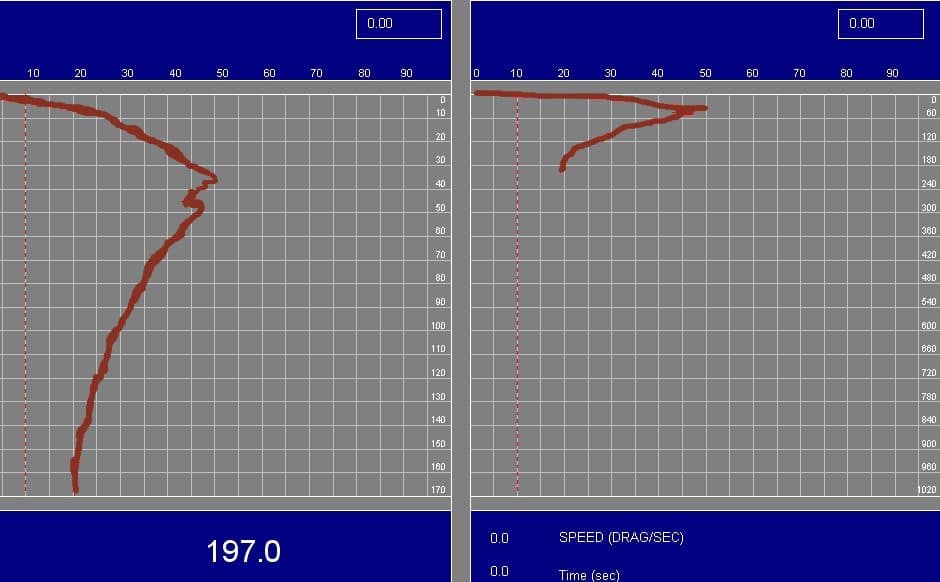
  • Allows in-situ measurement of the peak, residual and remoulded undrained shear strength
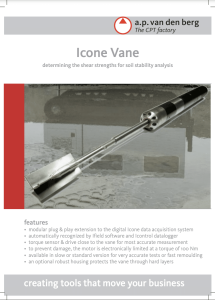
  • Electric motor drive and torque measurement are at the bottom of the rods, just above the vane, significantly improving results integrity by minimising friction

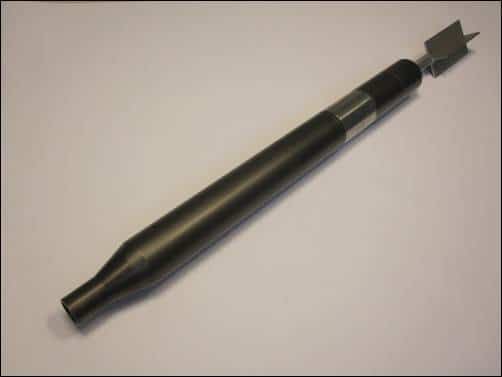
The A.P. van den Berg Icone Vane is unique in the fact that the electric motor drive and torque measurement are at the bottom of the rods, just above the vane, significantly improving results integrity by minimising friction. This eliminates the need for a slip joint or any other form of rod friction correction, as there is no rod friction. This is particularly important in jobs with very soft conditions where friction corrections can “swamp” the vane torque readings, making outcomes less reliable.

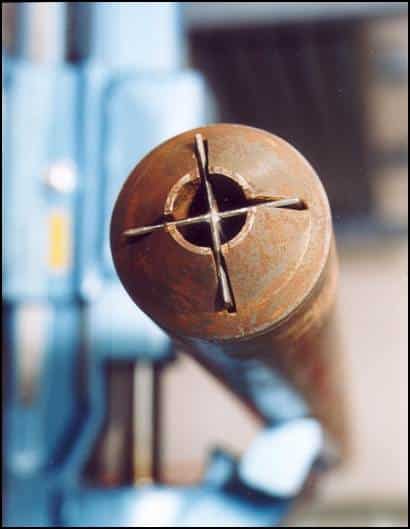
The Vane Shear Test (VST) equipment consists of a four-blade, stainless steel vane attached to a steel rod that will be pushed into the ground. The Icone Vane can be supplied with several blades sizes. The blade size is generally selected depending on the anticipated peak undrained shear strength at the target depth. To prevent damage, the drive motor and torque assembly are preconfigured to apply a maximum torque.

Vane Rotation Speeds from Slow to High Speed

The computer controlled harmonic drive system on the torque motor allows the rotation rate for testing to be selected within the range of each of the three models.

Icone Vane Slow – adjustable rotation speed of 0.1 to 6° per second for very accurate shear tests

  • For example in clays, a rotation speed of 0.1 degrees/second is used to measure the peak undrained shear strength and a higher rate, of up to 6 degrees/second, is used for remoulding followed by measuring the residual undrained shear strength at the lower rotation speed.
  • Max torque 100Nm

Icone Vane Fast – adjustable rotation speed of 0.2 to 12° per second for fast remoulding of the soil in situations with a low shear value.

  • Max torque 100Nm

Icone Vane HS (High speed) – in soft mine tailings, an adjustable rotation speed of 1 to 60° per second can provide sufficient reactive force/torque and therefore improved determination of the drained and undrained shear strength, resulting in more reliable stability analyses of mine tailings.

  • Suited to VERY soft sediments
  • For example, 1 degree per second until the ground has sheared. Then 60 degrees per second – remoulding speed. Stirring 10x faster gives more reaction force which provides more information about thick water viscosity, soft sediments are detected, and it’s beneficial in production time as well.
  • Max torque 30Nm

Protected or Unprotected

The Icone Vane is available in protected or unprotected formats:

  • protected protects the vane from damage during pushing using a protection shoe. It is suited to pushing through stiffer materials, like embankments. The protected format increases the rate of production as it allows completion of various Electrical Vane Shear Tests (EVST’s) at different depths and eliminates drill outs and pulling out the equipment assembly between tests.


  • unprotected is suited for pre drilled holes or soft material

The unprotected format Icone Vane uses standard 36mm CPT rods to push the vane down.

The protected Icone Vane uses standard 36mm CPT rods to hold the vane and 56mm casing tubes are used to hold the protection shoe. Once the desired depth is reached, the vane blades are advanced and testing can begin.


Cone Penetration Test (CPT) Sales, Calibration, Service and Spare Parts

Insitutek are proud to represent A.P. van den Berg Cone Penetration Test (CPT) equipment in Australia, New Zealand and the Pacific Islands. Our CPT product range covers CPT rigs and pushers, data acquisition systems, click on plug in and play modules for down hole Electrical Shear Vane Testing (EVST), Seismic CPT (SCPT), Conductivity and Magneto and MOSTAP soil sampling. We provide a high level of client support, from technical pre-sale consultations and supply of equipment to commissioning, user training, after-sale technical support, servicing, repairs, and calibrations. Our service centre is also well stocked with spare parts and consumables.

To find out more, Contact Us.

-
Application of Advanced In Situ Testing - Mark Chapman & Allan McConnell AGS Sydney Symposium 2024

Application of Advanced In Situ Testing - Mark Chapman & Allan McConnell AGS Sydney Symposium 2024

Categories: Research Papers

Published: 29/11/2024

In situ testing equipment and methodologies have evolved rapidly over the last 5 years. This paper looks at three devices that demonstrate this evolution: (1) a Special Purpose 3MPa CPTu Cone; (2) the automated Medusa flat plate dilatometer; and (3) the automated down-the-hole Vane Shear device.

CPTu cones are now commercially available with special internal design and with capacities as low as 3MPa. These “special” cones, when carefully calibrated, are capable of reliably measuring CPTu parameters in soils right to the bottom end of the very soft range. The cones come with a temperature sensor to enable the management of potential inaccuracies associated with transient temperature effects during the penetration.

The Medusa DMT, was developed by Marchetti to provide technicians and engineers with complete control and repeatability of the DMT diaphragm inflation and measurement process, eliminating many of the operator-dependant variables often encountered with the traditional gas-operated DMT.

The Vane Shear Test is perhaps the most relied-upon geotechnical strength test; however traditionally it has had in-built potential errors, particularly in very soft soils, mainly due to ambiguity in friction corrections; it has been traditionally restricted to use in pure clay or clay-like soils. Equipment design has evolved (in some equipment) to eliminate the friction-correction problem. High quality calibration is required.

These advanced in situ testing tools and improved methodologies were utilised in combination to characterise a low strength soil deposit in Sydney Harbour for a major infrastructure project. The results from the use of the advanced equipment and methods are discussed and reviewed in this paper.

Keywords: Dilatometer Marchetti Test - DMT, Vane Shear Test VST

Establishing a Site-Specific Standard of Practice for Field Vane Shear Testing in Mine Tailings - J Harvey, A Hogan - Tailings and Mine Waste 2023

Establishing a Site-Specific Standard of Practice for Field Vane Shear Testing in Mine Tailings - J Harvey, A Hogan - Tailings and Mine Waste 2023

Categories: Research Papers

Published: 08/11/2023

Country: Array

The field vane shear test (FVT) provides the only direct measurement of in-situ yield and residual undrained shear strength and is widely used in geotechnical practice. However, use of this test in mine tailings requires modifications from the ASTM standard to achieve and maintain undrained conditions. This paper advances research presented in recent publications that identified concerns with the accuracy of data obtained in mine tailings using the ASTM standard, as well as those introducing high-speed FVT equipment and modified procedures for mine tailings applications. Herein, the authors present the results and interpretation of a field investigation program commissioned by a confidential mining client across multiple tailings storage facilities (TSFs). The investigation used these modified procedures and high-speed FVT equipment with the objective of mitigating risk associated with the uncertainty of whether FVT results used for selection of design parameters were in an undrained condition.

To this end, a series of FVTs were performed at the same depths in adjacent soundings using a range of vane rotation rates for evaluation of both drainage and viscous effects on the measured yield and residual undrained shear strength. Companion cone penetration test (CPT) soundings with pore water pressure dissipation (PPD) tests were also conducted to support the characterization and interpretation. Results from this program demonstrate how the client, in a practical manner, was able to validate their standard of practice for high-speed FVT and determine optimal vane rotation rates that achieve undrained conditions while avoiding viscous effects for the various mine tailings across their portfolio of TSFs. For the mining industry, this provides a model for implementation of similar investigation programs at other TSFs to gain site-specific knowledge of vane rotation rate effects on the measured undrained shear strength for respective mine tailings, as well as a basis and directive for development of modified standards for mine tailings applications superseding the existing ASTM standard.

Keywords: Cone Penetration Test - CPT, Vane Shear Test VST

Modified field vane technology for improved reliability of undrained shear strength measurements in mine tailings - Conference 2022

Modified field vane technology for improved reliability of undrained shear strength measurements in mine tailings - Hogan, A.A., Kelly, S.A., Storteboom, O. and Robertson, P.K - Tailings and Mine Waste Conference 2022

Categories: Research Papers

Published: 01/01/2022

Country: Array

During mine tailings site investigations, the Field Vane Test (FVT) is commonly used as an accessory to Piezocone Penetration Testing (CPTu) for in-situ determination of undrained shear strength in fine-grained soil. Recent studies have identified concerns with the accuracy of the traditional ASTM standardized FVT in mine tailings. The occurrence of dam failures has demonstrated an industry-wide need to improve the reliability of in-situ undrained shear strength evaluation. Gregg Canada, in collaboration with A.P. van den Berg, present a novel innovation: a field vane with high-speed capability. In a case study from two tailings sites, the time factors (T) from FVTs completed using the traditional method and the high-speed method are compared. The results from this study indicate that the high-speed field vane is effective in providing rotation rates sufficient to maintain undrained conditions during a FVT in silty tailings, thus improving the reliability of measurements for undrained shear strength.

Keywords: Cone Penetration Test - CPT, Vane Shear Test VST

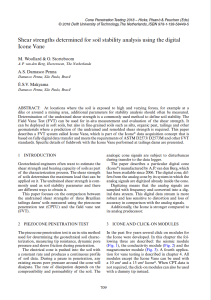
Shear strengths determined for soil stability analysis using the digital Icone Vane - Woollard, Storteboom, Damasco Penna & Makyama - Cone Penetration Testing CPT 2018

Shear strengths determined for soil stability analysis using the digital Icone Vane - Woollard, Storteboom, Damasco Penna & Makyama - Cone Penetration Testing CPT 2018

Categories: Research Papers

Published: 01/01/2018

Country: Array

At locations where the soil is exposed to high and varying forces, for example at a dike or around a mining area, additional parameters for stability analysis should often be measured.

Determination of the undrained shear strength is a commonly used method to define soil stability. The Field Vane Test (FVT) can be used for in-situ measurement and evaluation of the shear strength. It can be deployed in soft soils, but also in fine-grained soils such as silts, organic peat, tailings and other geomaterials where a prediction of the undrained and remolded shear strength is required. This paper describes a FVT system called Icone Vane, which is part of the Icone® data acquisition concept that is based on fully digital data transfer and meets the requirements of ASTM D2573/ D2573M and other FVT standards. Specific details of fieldwork with the Icone Vane performed at tailings dams are presented.

Keywords: Cone Penetration Test - CPT, Vane Shear Test VST

Icone Vane

Icone Vane (downhole electric shear vane)

Trusted by our clients

Trusted by our partners

Insitutek Blogs