
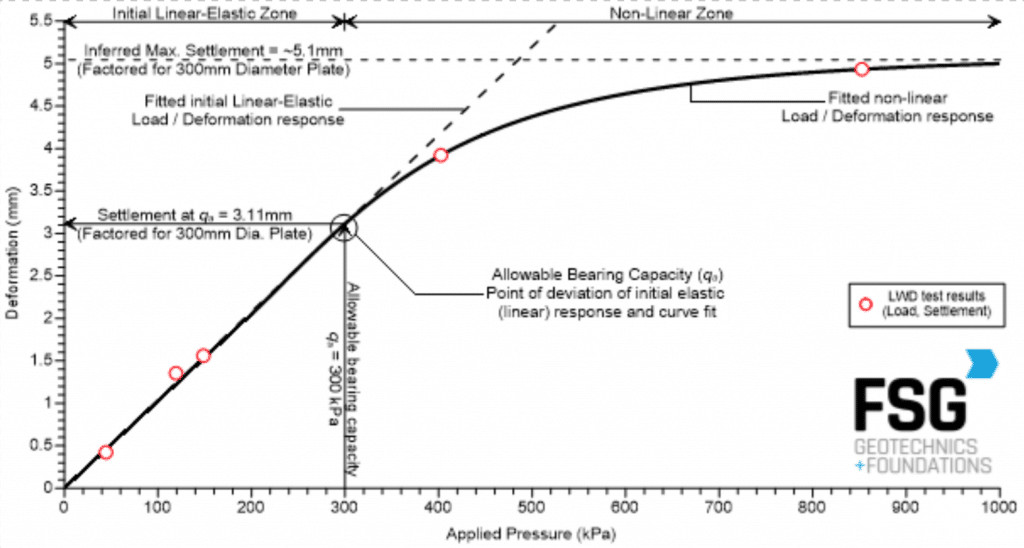
Clients are always looking for ways to better understand the ground conditions at a specific point in time, and how the bearing capacity of a site has altered due to changing conditions, like rain.
Let’s take a crane lift as an example. The insitu ground conditions need to be identified for the temporary works platform to be designed. However, immediately prior to the crane lift, the insitu conditions must be verified. This checks that site conditions still match the design assumptions. Being able to provide real-time results from tests that directly model the proposed loading scenario is essential.
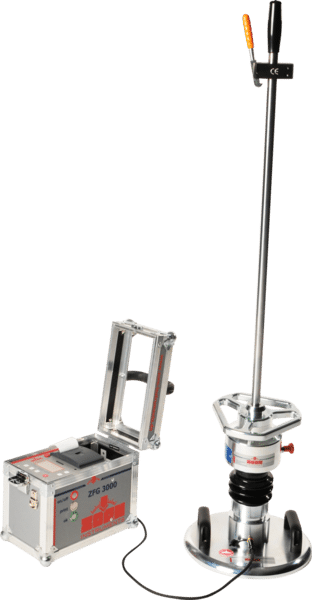
This article describes the Zorn Light Weight Deflectometer (LWD) as an example of equipment suitable for verifying ‘as-encountered’ site conditions. Safety factors are not considered.
Varying the Applied Load
The LWD, used in its standard calibrated configuration (10 kg weight, full height drop, and 300 mm plate), provides a single stress vs. deflection data point — i.e. deflection magnitude under 100 kPa stress. However, by varying the weight mass, plate diameter (and potentially drop height), users can construct an extended stress vs. deflection dataset. This allows determination of the linear (elastic) response and identification of the allowable bearing capacity.
Available configurations include 10 kg and 15 kg drop weights, and 300 mm and 150 mm diameter plates.
Example test configurations and their approximate applied stress:
- 15 kg drop weight, 300 mm diameter plate – Approx. 150 kPa stress
- 10 kg drop weight, 150 mm diameter plate – Approx. 400 kPa stress
- 10 kg drop weight, 300 mm diameter plate – Approx. 100 kPa stress
After factoring in the varying plate diameters, the measured deflections are graphed as deflection vs. applied pressure. The allowable bearing capacity is represented by the point of deviation from the initial linear response. If the applied stress is high enough, the ultimate bearing capacity may also be identified.
To provide additional data points, users can vary the drop height within any specific weight/plate configuration. For example, the drop height could be divided into thirds — one being the calibrated height (full drop), and the others temporarily marked along the shaft. While the Zorn LWD doesn’t include a load cell, users can estimate the applied pressure at each drop height proportionally. Conduct the test as normal, and deflections will be recorded. These additional readings serve as supplementary (approximate) stress vs. deflection data points.
Note: Deflections measured from the LWD — a dynamic, surface-based test — reflect the composite response within its limited penetration depth (zone of influence). Interpretation is still needed to confirm the applicability of results to the proposed outrigger dimensions.
Using the LWD to directly demonstrate allowable bearing capacity onsite represents a shift from the traditional Safety Factor-based approach used with other geotechnical tests.
Remember, the depth of influence is limited by the diameter of the base plate, as is also the case with a Plate Load Test.
Since each test takes less than 3 minutes and results are GPS-located, a single operator can carry out a large number of tests quickly and efficiently.
Confirmation of Load Capacity and Why You Would Choose the Light Weight Deflectometer
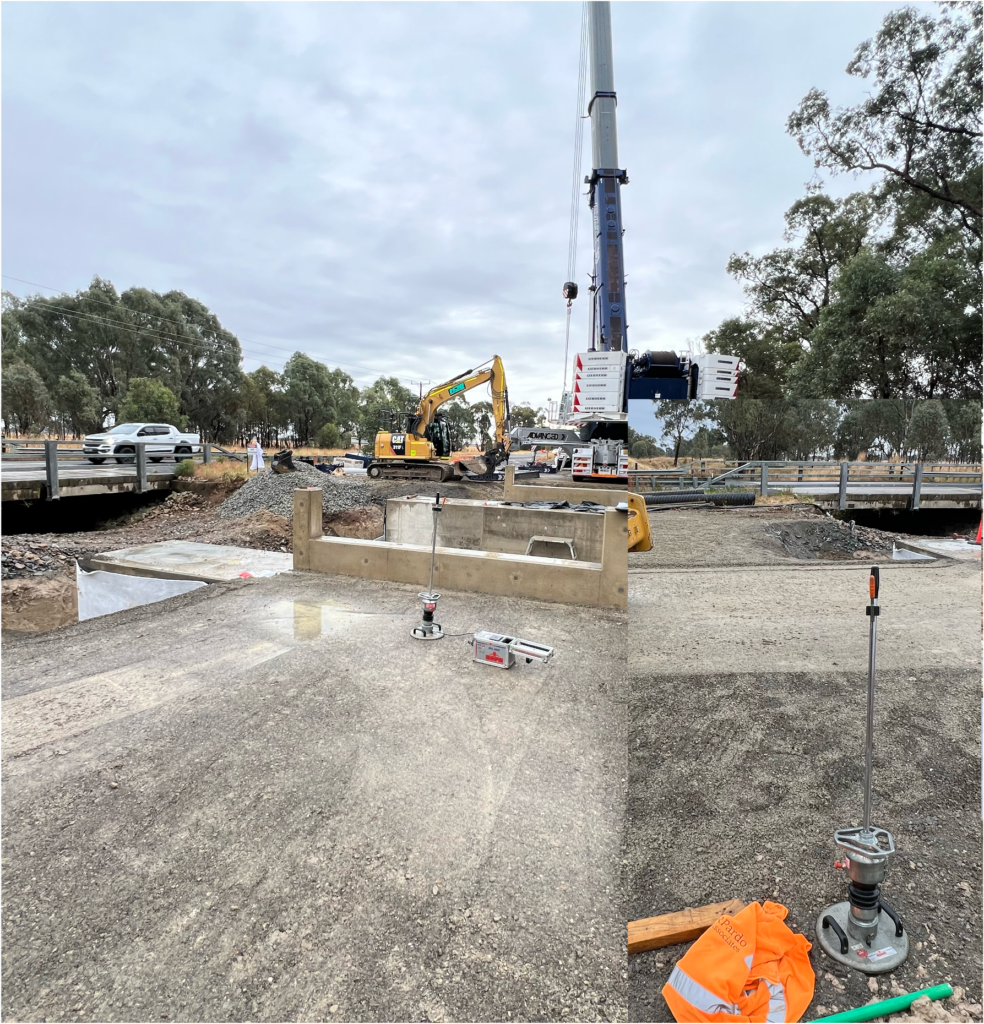
The Light Weight Deflectometer (LWD) is used as a tool to confirm the load capacity of an embankment, safe working platform or designated piling or crane pad locations and provide immediate actionable results to the operator. Several test locations on the working platform can be tested very quickly, enabling variability across the working platform to be assessed.
The LWD is also a rapid method to confirm compaction level has been achieved, i.e. deflection control, method specification, modulus confirmation for materials that cannot be tested for density using the traditional method, e.g. oversize materials, ballast, miscellaneous fill with high rock content, or where access with a nuclear densometer is not possible or not advised.
The LWD is used for time critical process validation, e.g. overnight or weekend rail occupation, where there is not time to wait for density results, as the works must be completed during a short period of time.
In conclusion, the Light Weight Deflectometer is a valuable tool for directly demonstrating a site’s allowable bearing capacity, and monitoring how those values may vary with changing conditions throughout the duration of a project.

